
 Armenian
 German
 Spanish
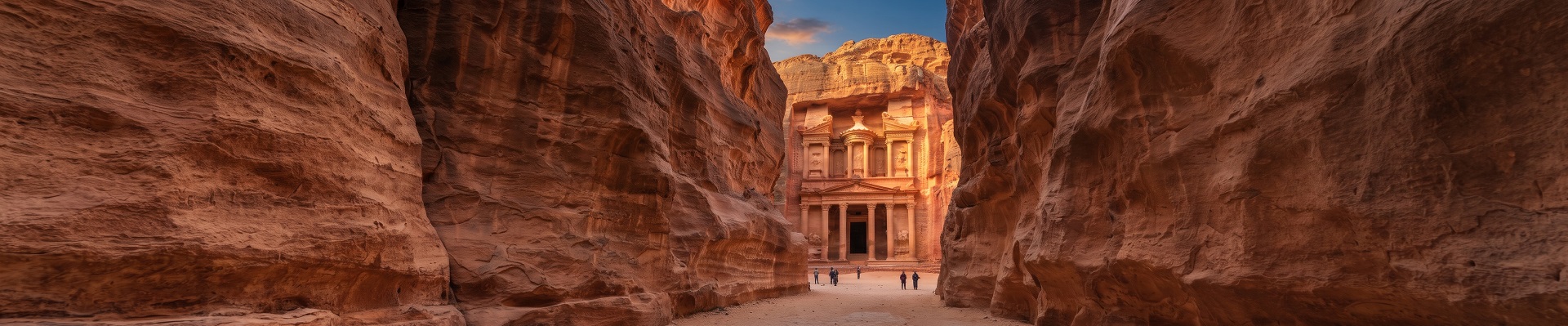

Jordan is a small kingdom with a very long memory. Shepherds, prophets, Roman engineers, Nabataean traders and Crusader knights have all crossed this land, and each of them left something behind in the stone. Today the country welcomes travellers with the same calm generosity that once greeted caravans arriving from the desert.
A Land Between Deserts and Seas
Jordan sits at the heart of the Middle East, bordered by Syria, Iraq, Saudi Arabia, Israel and the Palestinian territories. Most of its territory is desert, yet the landscape changes constantly. In the north, olive groves and pine forests cover rolling hills. In the west, the Jordan Valley drops toward the Dead Sea, the lowest point on the surface of the Earth. In the south, red sandstone mountains rise above the sands of Wadi Rum, and the road finally ends at Aqaba, where the Red Sea glows turquoise over coral reefs.
You can drive from one end of the country to the other in a single day. In that one drive, you pass through three or four completely different worlds.
Layers of History
Few places hold so many civilisations in such a small space. The Nabataeans carved Petra out of rose coloured cliffs. The Romans built Jerash, a city of columns and theatres that still feels lived in. Early Christians laid the mosaic floors of Madaba, and the Umayyad caliphs decorated their desert lodges with frescoes of hunters and musicians. Crusaders and Saladin's armies fortified the hilltops at Kerak and Ajloun.
Jordan is also a land of faith. Pilgrims come to Mount Nebo, where Moses is said to have looked upon the Promised Land, and to Bethany Beyond the Jordan, the site associated with the baptism of Jesus.
Hospitality
Ask any traveller what they remember most about Jordan, and many will talk about the people. "Ahlan wa sahlan," you will hear again and again, meaning you are welcome here. In Bedouin tradition, a guest is offered bitter coffee scented with cardamom, poured in small cups. Shake your cup gently when you have had enough; otherwise your host will keep refilling it.
Amman, the capital, is a modern city of white stone houses spread over many hills. Its cafés, galleries and lively streets show a young and open side of the country.
Flavours of Jordan
The national dish is mansaf, lamb cooked in a sauce of fermented dried yoghurt and served over rice, traditionally eaten with the right hand from a shared platter. Maqluba, whose name means upside down, is a pot of rice, vegetables and meat turned out onto a tray with real ceremony. Breakfast means hummus, falafel, warm bread and olive oil. For dessert, try knafeh, a hot pastry of soft cheese soaked in syrup, ideally from a busy shop in downtown Amman.
When to Go
Spring, from March to May, and autumn, from September to November, bring the most pleasant weather. The hills turn green in spring and wildflowers appear even in the desert. Summer is very hot in the south and around the Dead Sea, though Aqaba stays popular with divers all year. Winter can be cool and rainy in Amman, and nights in Wadi Rum get cold in every season.
Getting There and Around
Most travellers arrive at Queen Alia International Airport, about 35 kilometres south of Amman. King Hussein International Airport in Aqaba serves the south. Renting a car gives the most freedom. The ancient King's Highway winds past Madaba, Kerak and Dana on its way to Petra, and it is one of the most beautiful roads in the region.
The Jordan Pass is worth buying before you arrive. It covers entry to Petra and dozens of other sites, and it also covers the tourist visa fee for visitors who stay at least three nights. The local currency is the Jordanian dinar.
In Magelline's Eyes
Jordan rewards the traveller who slows down. Stay a few days longer than you planned, accept the coffee, and let the desert set the rhythm of your journey. This is a country where every road leads to a story, and most of those stories are thousands of years old.



