
 Armenian
 German
 Spanish

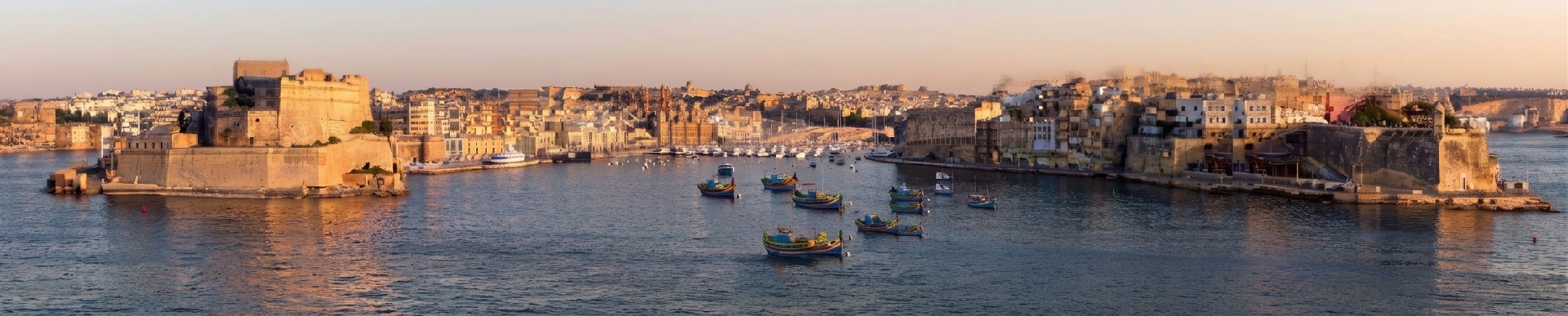
Malta sits in the middle of the Mediterranean, about 80 kilometres south of Sicily. The Republic of Malta is an archipelago of three inhabited islands: Malta, Gozo and Comino. Together they cover only 316 square kilometres, yet they hold three UNESCO World Heritage Sites, temples older than the Egyptian pyramids and a Baroque capital built by knights. You can cross the main island by car in under an hour, and almost every road ends at the sea.
Valletta, the Capital of the Knights
Valletta was founded in 1566 by Grand Master Jean de Valette of the Order of St John, one year after the knights survived the Great Siege of 1565 against the Ottoman fleet. The whole city has been a UNESCO World Heritage Site since 1980. Its straight streets run down to the water on both sides, lined with limestone the colour of honey and wooden balconies painted green, red and blue.
Walk to the Upper Barrakka Gardens for the classic view over the Grand Harbour. Below the terrace, the Saluting Battery still fires its cannon every day at noon.
St John's Cathedral
From the outside, St John's Cathedral in Valletta looks plain. Inside, it is one of the richest Baroque interiors in Europe. Officially, it shares cathedral status with St Paul's Cathedral in Mdina. The Knights built it between 1573 and 1577, and the painter Mattia Preti later covered the vault with scenes from the life of St John the Baptist. About 400 knights lie beneath the floor under tombstones of inlaid coloured marble.
The Oratory holds Caravaggio's The Beheading of Saint John the Baptist, painted in 1608. It is his largest canvas and the only one he ever signed.
The Three Cities
Across the Grand Harbour lie Birgu, Senglea and Cospicua, known together as the Three Cities. The knights settled here first, long before Valletta existed. Fort St Angelo, at the tip of Birgu, was their headquarters during the Great Siege. Cross from Valletta by dghajsa, the traditional water taxi, or by ferry, and you arrive in quiet lanes where washing hangs between stone houses.
Mdina
Mdina was the capital of Malta before the knights arrived. The walled town stands on a hill in the centre of the island and has only a few hundred residents, which is why the Maltese call it the Silent City. Cars are almost entirely kept outside the walls. Climb to the bastions at sunset and you can see across the whole island.
Next door, the town of Rabat has St Paul's Grotto and St Paul's Catacombs, a vast underground cemetery from Roman times.
Hal Saflieni Hypogeum
In the town of Paola lies an underground necropolis carved into soft limestone from around 4000 BC. The Hal Saflieni Hypogeum descends through three levels, and red ochre spirals are still visible on its ceilings. It became a UNESCO World Heritage Site in 1980.
Entry is limited to 80 people a day in groups of 10, and photography is not allowed. Book through Heritage Malta weeks or even months ahead.
Megalithic Temples
Hagar Qim and Mnajdra stand on the southern cliffs above the sea, facing the islet of Filfla. They were built roughly between 3600 and 3200 BC, which makes them older than Stonehenge and the pyramids of Giza. At Mnajdra, the first rays of sunrise on the spring and autumn equinoxes pass straight through the main doorway. Together with Ggantija on Gozo and three other sites, Tarxien, Ta' Hagrat and Skorba, they form the UNESCO World Heritage Site of the Megalithic Temples of Malta.
Blue Grotto & Marsaxlokk
On the south coast, small boats leave from a cove near Zurrieq for the Blue Grotto, a group of sea caves where the water glows bright blue on calm mornings. Nearby, Marsaxlokk is Malta's main fishing village. Its harbour is full of luzzu boats painted in bright colours with an eye on the bow, an old Mediterranean symbol of protection. On Sundays, the waterfront turns into a large fish market.
Gozo
Gozo is greener, slower and smaller than Malta. The ferry from Cirkewwa to Mgarr takes about 25 minutes. In the island's capital, Victoria, the walls of the Cittadella give a view over all of Gozo. Ggantija, near Xaghra, is one of the oldest freestanding buildings on Earth and dates from about 3600 BC.
At Dwejra on the west coast, the famous Azure Window arch collapsed into the sea during a storm on 8 March 2017. The Inland Sea and Fungus Rock remain, and divers now explore the fallen arch underwater. For a beach day, Ramla Bay has sand of a reddish gold.
Comino & the Blue Lagoon
Comino, between Malta and Gozo, covers only 3.5 square kilometres and has almost no permanent residents. Its Blue Lagoon is famous for clear turquoise water over white sand. Since 1 May 2025, every visitor who goes ashore must book a free online time slot, and no more than 4,000 people are allowed there at once. Come in spring or autumn for calmer water and fewer boats.
Frequently Asked Questions
- What is Malta famous for? Malta is famous for its prehistoric temples, which are older than the pyramids of Giza, and for Valletta, the Baroque capital built by the Knights of St John. The islands have three UNESCO World Heritage Sites: Valletta, the Hal Saflieni Hypogeum and the Megalithic Temples of Malta.
- Do you need to book the Hal Saflieni Hypogeum in advance? Yes. Only 80 visitors a day are allowed, in groups of 10, so tickets from Heritage Malta often sell out weeks or months ahead.
- Do you need a booking for the Blue Lagoon on Comino? Yes. Since 1 May 2025, every visitor who goes ashore needs a free online booking for one of three daily time slots, and no more than 4,000 people may be there at once.
- How do you get from Malta to Gozo? A car and passenger ferry runs from Cirkewwa in the north of Malta to Mgarr on Gozo. The crossing takes about 25 minutes.
- Can you still see the Azure Window on Gozo? No. The Azure Window collapsed into the sea during a storm on 8 March 2017. Visitors still come to Dwejra for the Inland Sea and Fungus Rock, and divers explore the fallen arch underwater.
In Magelline's Eyes
Malta has always been shaped by voyages. St Paul was shipwrecked here in AD 60, the knights arrived by sea in 1530, and every power in the Mediterranean wanted to hold its harbours. Give the islands at least four days: two for Valletta and the Three Cities, one for Mdina and the temples, and one for Gozo. The best months are April to June and September to November, when the sea is warm and the streets are not crowded. The Magelline team will gladly help you plan the route.