
 Armenian
 German
 Spanish
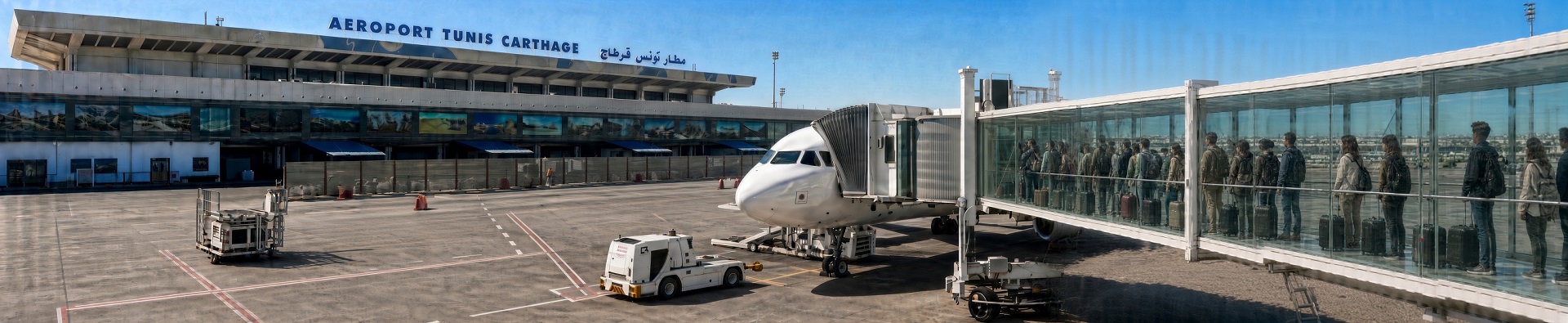
Tunisia sits on a short hop from southern Europe. Most flights from Italy, France, or Spain take under two hours. Almost everyone arrives by air. The network is split in two: Tunis-Carthage for year-round scheduled and business traffic, and three coastal airports built mainly for summer charter waves.
None of the terminals has a rail station inside the building. From the curb you use the motorway, a hotel shuttle, or a taxi.
Infrastructure
The airport network reflects a sharp divide in purpose. On one end are older state-run hubs carrying daily scheduled routes. On the other are massive, privately managed terminals built specifically to absorb holiday charter flights during peak summer months. While runways and check-in halls in the newer facilities are built for wide-body jets, processing speed drops noticeably when several flights arrive at once.
Getting from the tarmac to your final destination depends almost entirely on road transport. Despite marketing claims about integrated transit networks, no Tunisian airport features a direct rail link inside the terminal. Arriving passengers rely on expressways, hotel shuttle buses, and local taxis to reach central train stations, historical medinas, or coastal resorts. Highways along the eastern coast are well-maintained, but navigating terminal pickup zones requires patience.
Main Airports
Tunis-Carthage International Airport (TUN)
Located in the capital, TUN is the country’s main gateway for scheduled international carriers, government travel, and business. It handles steady year-round traffic, though the aging infrastructure frequently struggles with long queues at security and immigration during peak hours.
Djerba-Zarzis International Airport (DJE)
Serving the southern island of Djerba, DJE caters almost exclusively to holidaymakers, cultural tourists, and resort traffic. It operates as a vital seasonal pipeline for the south.
Enfidha-Hammamet International Airport (NBE)
A modern, high-capacity facility built between Tunis and Sousse, NBE was engineered to funnel large volumes of European charter passengers directly to the Hammamet and Sahel beach zones without overloading the capital.
Monastir Habib Bourguiba International Airport (MIR)
Positioned near historic Monastir, MIR remains a primary secondary landing point for seasonal charters servicing central eastern resorts.
Travel Tips
- Expect multiple security checkpoints. Queues form quickly when tourist charters land simultaneously, so keep travel documents accessible.
- Terminal signage appears in Arabic, French, and English, making basic navigation manageable. However, seasonal crowds require realistic timing.
- Arrive three hours early for international flights from June through September. Two hours is enough during quieter winter months or for domestic routes.
Transportation
Ignore unmetered drivers inside the arrivals hall. Walk to official taxi stands outside and explicitly insist that the driver turns on the meter before departing. Alternatively, arrange private hotel transfers in advance.
Magelline Perspective
Tunisia’s airports reflect a nation balancing corporate necessity with seasonal tourism. The network functions well enough to shuttle millions across the Mediterranean, but travelers should expect clear contrasts between shiny modern charter terminals and congested urban hubs. Leaving the terminal instantly trade smooth air corridors for the lively, chaotic reality of the coast.