
 Armenian
 German
 Spanish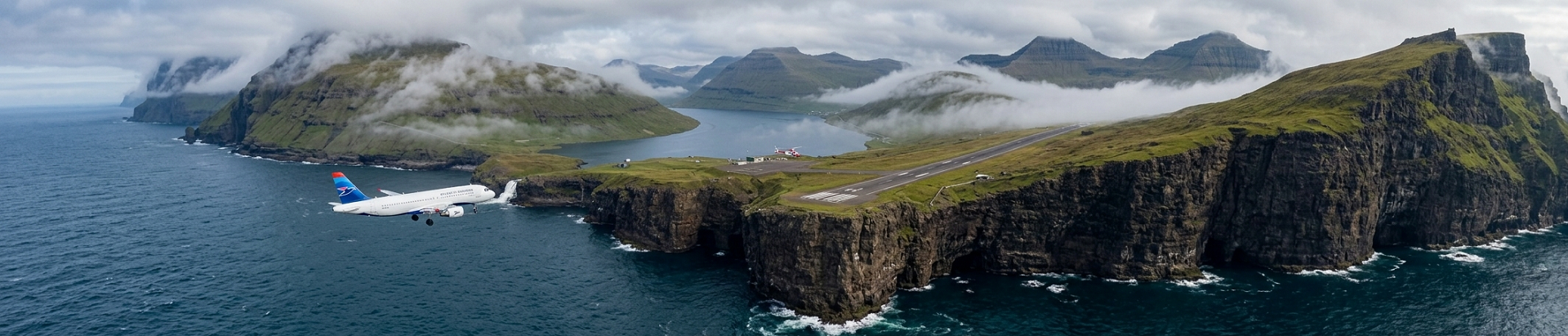
There is no gentle approach to the Faroe Islands. Aircraft arrive low over black cliffs and green fjords, the runway seeming to appear out of the mist at the last possible moment. This is flying as theatre, and it sets the tone for everything that follows on these eighteen volcanic islands scattered between Iceland and Norway.
Unlike most countries, the Faroe Islands do not offer a network of competing airports. Instead, the archipelago relies on a single runway and a small, remarkable web of heliports that stitch together communities otherwise reachable only by sea. It is an aviation system built for people first and tourism second, which is precisely what makes it so compelling to experience.
At the centre of it all sits Vágar Airport, the only fixed-wing gateway to the islands and the starting point for nearly every visitor's journey. From there, a fleet of helicopters operated by the national carrier Atlantic Airways continues the story, linking the capital, the second city, and a handful of settlements so remote that a helicopter is still, quite literally, a lifeline.
Below, a brief look at the leading airports and heliports of the Faroe Islands. Each will receive its own dedicated feature soon, with full details on facilities, transfers, and travel tips.
Vágar Airport (FAE)
Set beside a lake famous for its optical illusion, Vágar is the only proper airport in the Faroe Islands and home base for Atlantic Airways. Nearly every international arrival begins here, on the western island of Vágar, connected to the rest of the country by tunnel.
Tórshavn Heliport
The capital's heliport functions as the true hub of the domestic network. Most helicopter routes pass through here, making it the natural link between Vágar and the more distant island communities.
Klaksvík Heliport
Serving the Faroe Islands' second-largest town, this heliport connects the northern islands to the capital and to Vágar and doubles as a scenic gateway for travellers heading toward Kalsoy and the surrounding fjords.
The Outer Island Network
Beyond the central hubs, a chain of small heliports reaches communities such as Mykines, Svínoy, Fugloy, Skúvoy, and Suðuroy. These village landing points, some barely more than a patch of grass, remain essential connections for residents and an unforgettable experience for visitors chasing puffins or solitude.
For most travellers, the story begins and ends at Vágar. Buses and rental cars link the airport to Tórshavn along a coastal road that offers a preview of the drama still to come, past waterfalls, fishing villages, and impossibly steep hillsides. But it is the helicopter network that truly defines Faroese aviation, a public service reimagined as one of the most scenic short flights available anywhere in the world.
Booking a seat is refreshingly informal by international standards, yet visitors should plan carefully. Seats are limited, round trips are rarely possible on the same route, and weather can shift plans without warning. None of this diminishes the appeal. If anything, it adds to the sense that arriving in the Faroe Islands, by any means, is an achievement worth savouring.
At Magelline, we see the Faroe Islands' airport infrastructure as a rare thing: a transport system shaped entirely by geography and community rather than scale. There are no sprawling terminals here, no crowds to navigate, only cliffs, fog, and the quiet thrill of a helicopter lifting off toward the edge of the map. Explore our upcoming dedicated guides to each airport and heliport for everything you need to plan your own journey into this extraordinary corner of the North Atlantic.
