
 Armenian
 German
 Spanish

Jersey is a small island with a long memory. On barely 118 square kilometres, it holds Neolithic tombs and medieval castles, wartime tunnels and lighthouses on tidal rocks, granite cliffs in the north and wide sandy bays in the south. Twice a day the sea pulls back and uncovers a second landscape of reefs, sandbanks and rock pools, so the same view rarely looks the same for long.
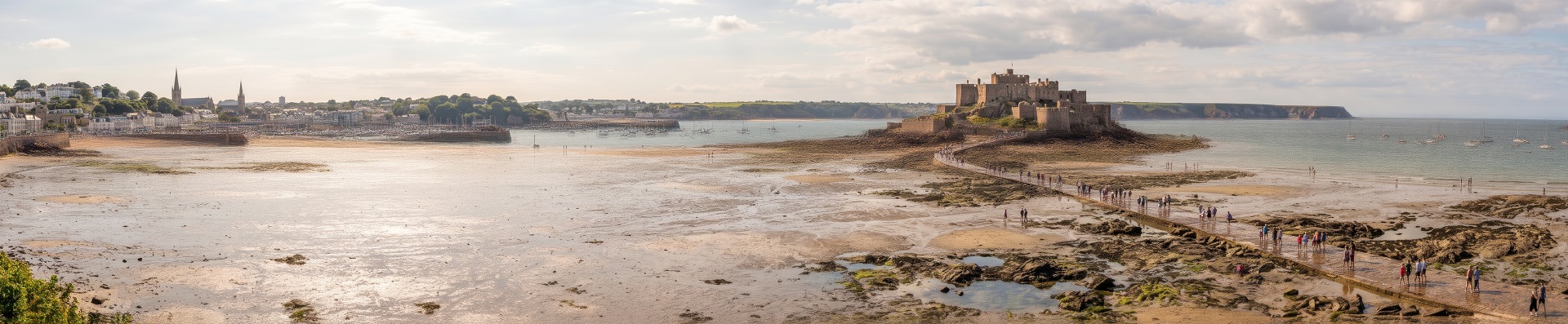
In St Helier, Elizabeth Castle stands on a rocky islet in St Aubin's Bay. At low tide you can walk out to it across the sand, and when the water returns an amphibious ferry carries visitors over the waves. In the town centre, Royal Square recalls the Battle of Jersey of 1781, and the Victorian Central Market still sells flowers, fish and island produce under its iron and glass roof. On the east coast, Mont Orgueil Castle has watched over Gorey harbour for about eight hundred years, ever since Jersey chose the English crown over Normandy in 1204. Inland, La Hougue Bie hides a Neolithic passage grave more than five thousand years old beneath a grassy mound crowned by a medieval chapel. The Jersey War Tunnels, dug by forced labourers during the German Occupation, tell the story of 1940 to 1945 with quiet honesty. In Trinity, Durrell Wildlife Park, founded by the naturalist Gerald Durrell in 1959, works to save some of the rarest animals on earth. In the far southwest, La Corbière Lighthouse rises from the rocks at the end of a causeway that vanishes at high tide. Further north, St Ouen's Bay runs for about eight kilometres of sand and surf, while the ruins of Grosnez Castle and the cliffs around Plémont and Devil's Hole show the wilder face of the north coast. Off the southeast shore, Seymour Tower can be reached on foot with a guide, across a seabed the tide leaves dry for only a few hours.
Away from the landmarks, Jersey's countryside has a charm of its own: green lanes between old granite farmhouses, cliff paths bright with gorse in spring, and one of the largest tidal ranges in the world, which turns the south and east coasts into vast fields of rock and sand at low water.
In Magelline's eyes, Jersey is at its best at low tide, when you cross the wet sand toward Elizabeth Castle and the noise of St Helier fades behind you. Few places let you reach a fortress on foot and come back by boat on the same afternoon.