 Armenian
 German
 Spanish
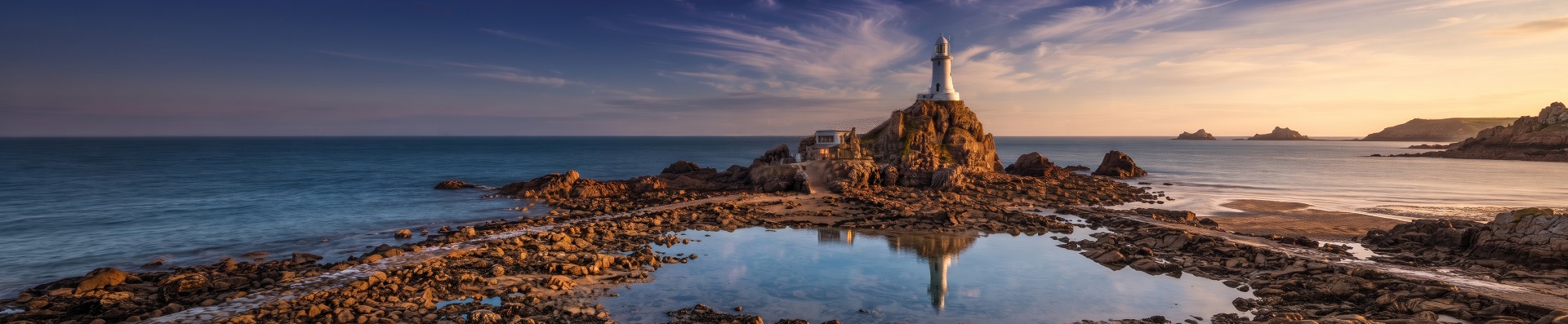

At low tide, the sea around Jersey seems to step back and leave the island larger than before. Boats rest on the sand in Gorey harbour, children with buckets wander out among the rock pools, and a castle that stood on its own island an hour ago is suddenly a short walk away. Then the water returns, quick and silver, and the coastline changes again. This is Jersey, a small island that redraws its own map twice a day.
Jersey is the largest of the Channel Islands. It lies in the Gulf of Saint Malo, about 22 kilometres off the coast of Normandy and roughly 140 kilometres south of England. It covers around 118 square kilometres and is home to about 103,000 people. As a British Crown Dependency, Jersey is loyal to the Crown but belongs to neither the United Kingdom nor the European Union, and it makes its own laws. The land tilts gently from north to south: high granite cliffs face the open Channel, while long sandy bays open to the south and west. Thanks to its southern position, Jersey is often one of the sunniest places in the British Isles, with mild winters and warm, breezy summers.
Language
English is the language of everyday life, so visitors have no trouble being understood. French, however, is everywhere you look. Street names, parish names and the names of old farmhouses come from French, and French was long the language of the island's courts and parliament. In the countryside you may still hear Jèrriais, Jersey's own Norman language. Few islanders speak it fluently today, but it is taught in schools, and in Jèrriais the island is called Jèrri.
Towns & Villages
St Helier, the capital and the only real town, is home to about a third of the population. Its marinas, granite streets and shopping lanes give it the energy of a much bigger place. West along the bay, St Aubin is a harbour village of painted houses, small galleries and seafood restaurants. On the east coast, Gorey curves around its harbour below the castle walls, and nearby Rozel sits in a green valley with a tiny fishing harbour. The island is divided into twelve parishes, each with its own church and great local pride, from green Trinity in the north to St Brelade and its golden bay.
Culture & History
People lived on this land long before it became an island. Ice Age hunters sheltered at La Cotte de St Brelade, one of the most important Neanderthal sites in Europe, and Jersey's Neolithic tombs are older than the pyramids of Egypt. In 933, the island became part of the Duchy of Normandy. When King John lost mainland Normandy to France in 1204, the islanders chose to stay with the English crown. That choice brought centuries of fortresses facing France and a culture that is both British and Norman at heart.
The hardest chapter came from 1940 to 1945, when Jersey and the other Channel Islands were the only British territory in Europe occupied by German forces. Victor Hugo lived here in exile in the 1850s, and the actress Lillie Langtry, the Jersey Lily, was born on the island.
People
Jersey people are friendly, practical and quietly proud of their independence. Along country roads you will see small roadside stalls selling potatoes, eggs, flowers and honey, with an honesty box for payment. On the narrow lanes, a raised hand thanks the driver who pulls over to let you pass.
Cuisine
Jersey cooking starts with the land and the sea. The famous Jersey Royal potatoes, protected by their own designation of origin, arrive each spring and taste best simply boiled with butter. The butter and cream come from the island's own Jersey cows. The seafood is superb: oysters from the Royal Bay of Grouville, lobster, crab, scallops and ormers, a prized local shellfish that may be gathered only on a few low tides each year. Try bean crock, a slow-cooked dish of beans and pork, and Jersey wonders, small twisted doughnuts. Black butter, or nièr beurre, is a dark spiced apple preserve made over long autumn nights, and local cider rounds off a meal.
Public Holidays & Festivals
The most meaningful day of the year is Liberation Day on the ninth of May, when the island remembers the end of the Occupation in 1945 with ceremonies, music and family gatherings. In August, the Battle of Flowers fills the streets with floats covered in thousands of blossoms, a tradition that began in 1902. In autumn, La Faîs'sie d'Cidre at Hamptonne celebrates the apple harvest with traditional cider making. At Christmas, St Helier glows with lights and markets.
Travel Tips
The best time to visit is from May to September, when the days are long and the sea is at its warmest. You can reach the island by air at Jersey Airport or by ferry from England and from Saint Malo in France. Entry rules follow those of the UK. The currency is the Jersey pound, equal in value to sterling. British notes work here, but Jersey notes are hard to use elsewhere, so spend them before you leave. Traffic drives on the left, and on the green lanes the limit is 15 miles per hour, with priority for walkers and cyclists. Before walking out to Elizabeth Castle or Seymour Tower, always check the tide times, because the sea returns faster than you expect.
In Magelline's view, Jersey deserves more time than most travellers give it. People come for a weekend and leave wishing they had booked a week. Bring the tide tables, and keep one evening free for the sunset over St Ouen's Bay.



