
 Armenian
 German
 Spanish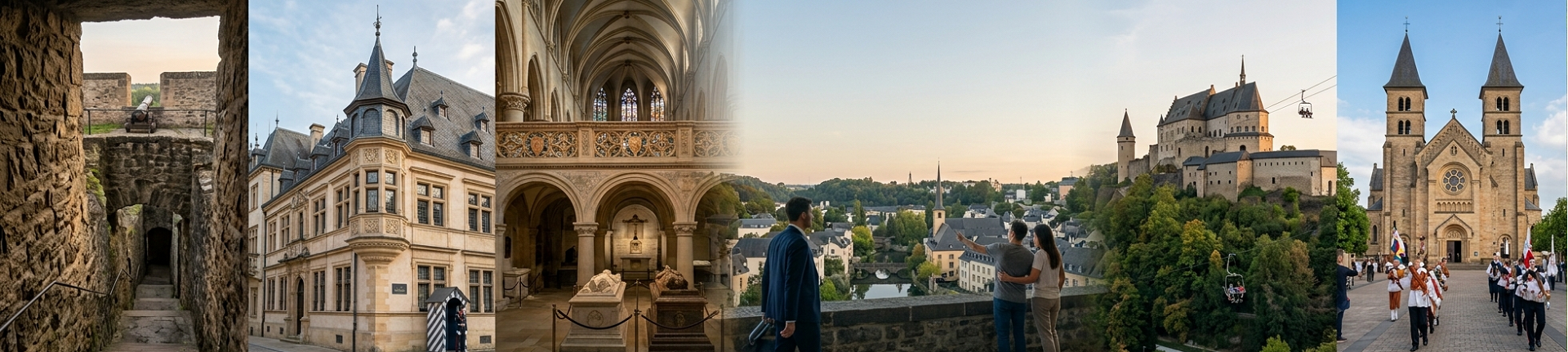
A country this compact hides nothing, yet somehow everything here still arrives as a surprise. The sights of Luxembourg sit close together, often within a single day of one another, but each carries enough history to fill a much larger nation. What follows are the places no first visit should miss.
The Bock Casemates
Everything began here. In 963, Count Siegfried acquired a rocky promontory above the Alzette and built the castle that gave the country its name, Lucilinburhuc, the little fortress. Over the next seven centuries, Burgundian, Spanish, French, Austrian, and Prussian engineers each added their own layers of defence, until the rock itself had been hollowed into a honeycomb. At their peak, the casemates ran for 23 kilometres; 17 kilometres survive, and walking them today means descending through galleries where garrisons once slept, cannons once fired through slits in the cliff face, and thousands of citizens sheltered during the bombardments of two world wars. The city earned the name Gibraltar of the North for a reason, and the reason is under your feet.
The Grand Ducal Palace
In the heart of the old town stands the city residence of the Grand Duke, a Flemish Renaissance facade of turrets and carved stonework dating to 1573. For most of the year, you watch the single sentry pace before the entrance. In summer, however, the palace opens for guided tours, and visitors walk through state rooms still in active ceremonial use. Few working royal residences in Europe let you this close.
Notre-Dame Cathedral
A few streets away, the cathedral holds the tension of its own history: a Jesuit church begun in 1613, late Gothic in its bones but with Renaissance ornament threaded through the portal and galleries. In the crypt lie the Grand Ducal family and John the Blind, the fourteenth-century king of Bohemia who died fighting at Crécy and remains a national hero. Every spring the Octave pilgrimage fills the nave with worshippers from across the country, a reminder that this is a living sanctuary rather than a monument.
Chemin de la Corniche
Rather than a single sight, this is the vantage point from which the capital explains itself. The walkway runs along the seventeenth-century ramparts, and below you the whole geography opens up: the Alzette winding through the valley, the abbey of Neumünster on its bank, the roofs of the Grund, the fortifications of the opposite plateau. Come twice, once in daylight to understand the city, once at dusk to fall for it.
Vianden Castle
An hour north, Vianden rises from its hilltop with an improbability that stops conversation in the car. Built between the eleventh and fourteenth centuries on Roman foundations, it was among the largest feudal residences west of the Rhine before falling into ruin; its restoration, completed in the twentieth century, returned it whole. Inside are the knights' hall, the Byzantine gallery, and the chapel built on two levels. In the town below stands the house where Victor Hugo lived in exile in 1871, now a small museum, and a chairlift carries visitors above the Our valley for the view the counts once defended.
Echternach & its Basilica
The oldest town in the country grew around the abbey founded by Saint Willibrord in 698. The basilica above his tomb remains a place of pilgrimage, and on Whit Tuesday the town performs its hopping procession, a swaying, springing dance through the streets that UNESCO has recognised as intangible world heritage. No one knows precisely how old the tradition is. That is part of its power.
The Schiessentümpel
Deep in the Mullerthal, where the Black Ernz stream drops through a triple cascade beneath a stone footbridge, stands the most photographed natural scene in the country. The waterfall is small. The setting, mossed rock and filtered forest light, is perfect. It rewards those who arrive early, before the trail fills.
The Luxembourg American Cemetery
At Hamm, just outside the capital, 5,000 American soldiers lie beneath white crosses and stars, most of them killed in the Battle of the Bulge. General George S. Patton is buried among them, facing his troops, at his own request. It is a quiet place, immaculately kept, and it explains more about Luxembourg's place in the twentieth century than any museum could.
? ? ?
Magelline Perspective
In Luxembourg, the distances are short and the centuries are deep. See the fortress that named the country, then the graves that freed it, all in a single day. Few countries let you hold a thousand years in one weekend.
