
 Armenian
 German
 Spanish
About a quarter of the Netherlands lies below sea level, and a large part of the country was reclaimed from water. You see that history almost everywhere you go. Distances are short, too. The fast train from Amsterdam reaches Rotterdam in about 40 minutes, so even a week here covers a lot of ground.
Amsterdam's Canal Ring
The Herengracht, Keizersgracht and Prinsengracht were dug in the 17th century, when Amsterdam was the busiest port in Europe. Plots along the water were narrow and expensive, so merchants built upwards. Look under the gables and you will still see the hooks used to haul furniture in through the windows.
The ring has been on the UNESCO list since 2010. A boat tour is worth doing once. After that, walk. The Nine Streets, a small grid of lanes between the canals, are good for an afternoon of browsing and a beer in a brown café, the dark wooden pubs where Amsterdammers have been drinking for centuries.
Rijksmuseum
Rembrandt's The Night Watch has its own room and draws a crowd from opening time. The canvas is smaller than Rembrandt painted it. In 1715 it was trimmed on all four sides to fit a wall in the town hall. The museum also owns four Vermeers, including The Milkmaid.
The building opened in 1885. A public cycle path runs right through the middle of it, and when the museum was renovated, cyclists campaigned hard to keep it.
Van Gogh Museum
Across Museumplein, the Van Gogh Museum holds about 200 of his paintings. Most of them came from his brother Theo's family, which is why the collection covers his whole short career. You can follow him from the dark peasant scenes of The Potato Eaters to the Sunflowers he painted in Arles. Entry is by timed ticket only.
Anne Frank House
Anne Frank, her family and four other people hid for two years in the back annex of this house on the Prinsengracht. The entrance was a hinged bookcase, and you walk through it. The rooms are bare because Otto Frank wanted them left that way after the war. Her original diary is on display. Tickets are sold only online, about six weeks in advance, and they go quickly.
Zaanse Schans
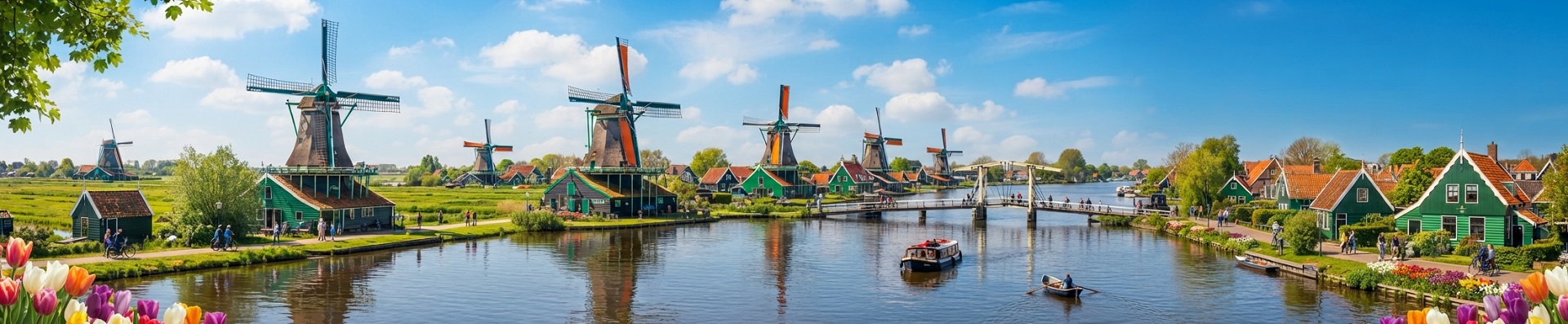
Most of the green wooden houses and windmills here were moved from other villages along the Zaan in the 1960s and 1970s to save them from demolition. Several mills still work. De Kat grinds pigments for artists' paint, and De Zoeker presses oil. The train from Amsterdam Centraal takes under 20 minutes. Come before ten if you can.
Kinderdijk
The name means children's dike. Local legend says that after a great flood in 1421 a baby in a wooden cradle washed up here, kept afloat by a cat jumping from side to side. The 19 windmills came later, around 1740, built to pump water off the polders. They have been a UNESCO site since 1997. Two are open inside as small museums. The waterbus from Rotterdam is the easiest way to get there.
Keukenhof
Keukenhof near Lisse opens for only about eight weeks a year, from late March into May. Some seven million bulbs are planted by hand every autumn. Tulips usually peak in mid April. The commercial bulb fields outside the park are just as striking, and you can rent a bike at the gate to ride through them.
Rotterdam
German bombing destroyed the centre of Rotterdam on 14 May 1940. The city never tried to copy what was lost, and today it has the most adventurous architecture in the country. The Markthal is a food market under a huge horseshoe arch, with flats built into the arch itself and a painted ceiling of oversized fruit and vegetables. A few steps away are Piet Blom's Cube Houses from 1984, tipped on their corners. Finish at the Erasmus Bridge, which locals call De Zwaan, the Swan.
The Hague
Amsterdam is the capital, but parliament, the government and the king all work in The Hague. The International Court of Justice sits here as well, in the Peace Palace, which Andrew Carnegie paid for.
The Mauritshuis is small enough to see in an hour or two. It has Vermeer's Girl with a Pearl Earring and his View of Delft, along with Rembrandt's Anatomy Lesson of Dr Nicolaes Tulp. Tram 1 will take you on to the beach at Scheveningen.
Giethoorn
Giethoorn in Overijssel became famous through Bert Haanstra's 1958 comedy Fanfare, which was filmed here. The old village has no streets at all. Houses sit on little islands, linked by more than 170 wooden bridges. Rent an electric whisper boat and steer it yourself. Summer day trippers fill the canals by late morning, so stay the night or come outside the high season.
Magelline’s Perspective
Base yourself in Amsterdam or Rotterdam and do Kinderdijk, The Hague and Keukenhof as day trips. Giethoorn deserves its own night, since it is about two hours away by train and bus. If you can choose your month, pick April for the tulips, or September, when the summer crowds have thinned and the weather usually holds.
