
 Armenian
 German
 Spanish

The Dutch like to say that God created the world, but the Dutch created the Netherlands . Walk along any dike and you see what they mean. Fields lie lower than the canals beside them, cows graze on what used to be seabed, and the land is so flat that a church spire many kilometres away still marks the horizon.
It is a small country with a big appetite for life outdoors. People cycle in the rain, eat herring standing at street stalls and fill every café terrace the moment the sun comes out.
Landscapes
Most of the west is polder land, green and level, cut into long strips by drainage ditches. In spring the bulb fields between Haarlem and Leiden turn into bands of red, yellow and purple.
A wall of dunes protects almost the entire North Sea coast. Further north lies the Wadden Sea, a UNESCO site where the tide retreats so far that you can walk across the seabed to the islands with a guide.
Inland, the Veluwe is heath and deep forest, home to red deer and wild boar. Only in Limburg, in the far south, does the land rise into gentle hills. Even there the highest point, the Vaalserberg, reaches just 322 metres.
Cities
Dutch cities sit close together, and most are less than an hour apart by train.
Amsterdam: Canals, gabled houses and some of Europe's finest museums, all within walking distance. The centre gets crowded in summer, while the Jordaan and De Pijp still feel like neighbourhoods where people actually live. Best for: museums, canal walks, nightlife Days needed: 3 to 4
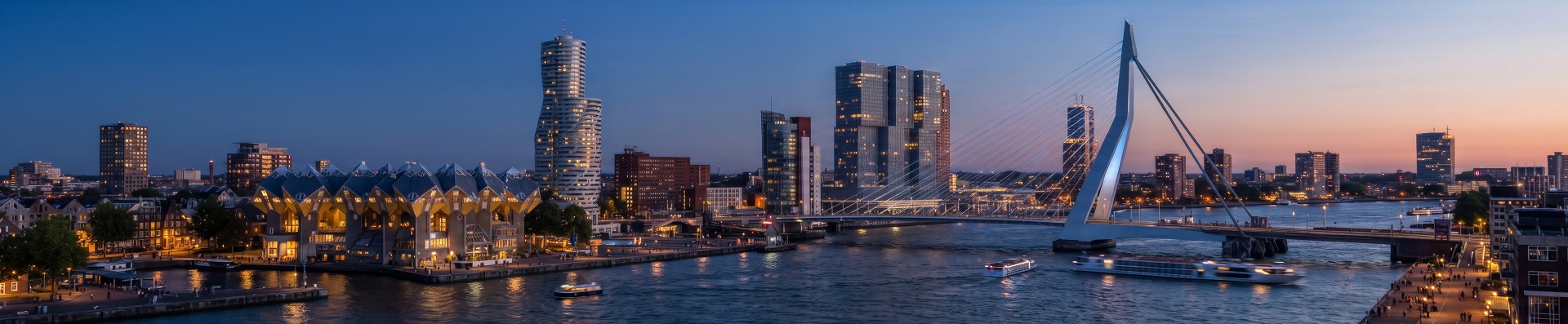
Rotterdam: Europe's largest port and the most modern city in the country, rebuilt after 1940 with bold, experimental architecture. Best for: architecture, food markets Days needed: 1 to 2
Utrecht: A university city with a medieval centre and canals lined with old wharf cellars, now turned into cafés at water level. Climb the 465 steps of the Dom Tower, the tallest church tower in the Netherlands. Best for: canalside cafés and a relaxed pace Days needed: 1
The Hague: The seat of government, with the Mauritshuis, the Peace Palace and a long sandy beach at Scheveningen. Best for: art, the seaside Days needed: 1 to 2
Delft: The town of Vermeer and of the famous blue and white pottery. Members of the royal family are buried in the New Church on the market square. Best for: Delftware, small town charm Days needed: 1
Maastricht: Close to the Belgian and German borders, Maastricht has a southern warmth all its own. One of its bookshops sits inside a 13th century Dominican church. Best for: food, wine, long lunches Days needed: 1 to 2
Food and Drinks
Dutch cooking is simple and filling. In winter that means stamppot, mashed potato stirred with kale or sauerkraut and served with a smoked sausage. Snack bars sell bitterballen, crisp fried balls of ragout dipped in mustard and eaten with a beer.
Market stalls offer raw herring with chopped onion and kibbeling, battered chunks of white fish. Cheese is everywhere, from young Gouda to crumbly aged wheels that taste almost of caramel. For something sweet, try a warm stroopwafel or a plate of poffertjes, tiny puffed pancakes dusted with sugar.
Centuries of trade with Indonesia left their mark as well. Rijsttafel, a spread of many small Indonesian dishes served with rice, is a favourite night out. To drink, ask for jenever, the Dutch ancestor of gin, or a beer from one of the many small local breweries.
Culture
This is the country of Rembrandt, Vermeer and Van Gogh, and its museums hold some of the most famous paintings in the world. Daily life is far more informal. The Dutch are known for speaking their minds, and almost everyone speaks good English.
The word gezellig has no exact translation. It describes the warm, easy feeling of a good evening with friends, and you will hear it constantly. On 27 April, King's Day, the whole country dresses in orange and the streets become one enormous flea market and street party.
Life on Two Wheels
The Netherlands has more bicycles than people. Children ride to school, and parents carry toddlers in wooden boxes on the front of cargo bikes. Cycle paths connect almost every town, and the garage at Utrecht Central Station holds around 12,500 bikes.
Renting a bike is the quickest way to feel like a local in the city. Pair that with the frequent and punctual train network, and you can cross the entire country in an afternoon.
Magelline Perspectives
The Netherlands was built by people who would not let the sea decide where they could live. That stubbornness is still visible in the dikes, and in cities that keep reinventing themselves. Come for the tulips and the masterworks, and save an afternoon for something ordinary: a slow ride through a polder village and a bike home along a dike as the light drops.



