 Armenian
 German
 Spanish

Every map of human wandering ends somewhere, and for a very long time it ended here. Long after people had settled the deserts, the steppes and the frozen north, two large islands at the bottom of the Pacific remained untouched, their forests full of birds that had never learned to fear anything walking on two legs. Polynesian navigators reached them only around seven or eight centuries ago, steering by stars and swells across open ocean. They called the land Aotearoa. It was the last great territory on Earth to receive its first people.
You feel that lateness the moment you arrive. The light is sharp and clean, the roads empty quickly beyond the towns, and the ground itself seems unfinished, as if it has not yet settled into its final shape. In a sense it hasn't. This is a country still being made, and travelling through it means watching the work in progress.
Landscape
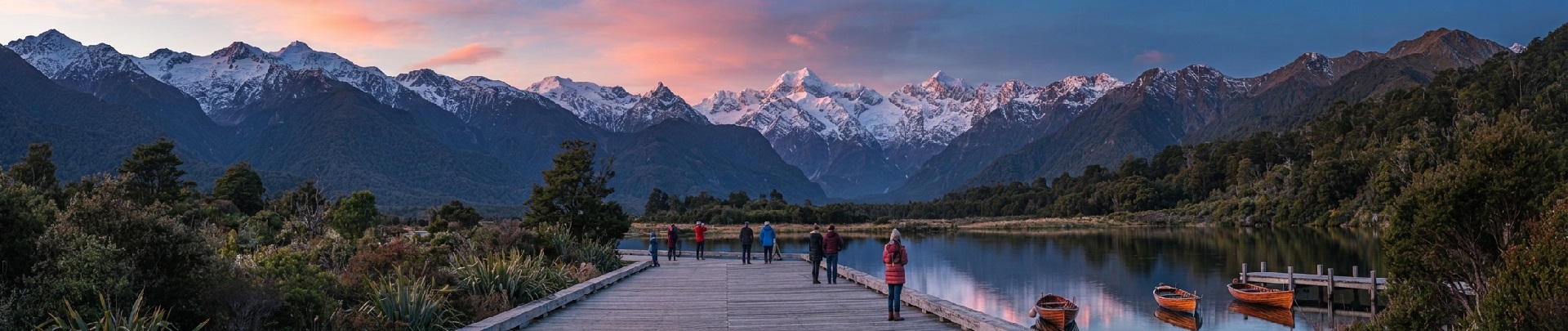
Two plates of the Earth's crust grind against each other beneath New Zealand, and almost everything you see follows from that meeting. On the South Island the collision has pushed up a long spine of mountains, the Southern Alps, still rising a little every year and worn down just as steadily by rain, ice and rivers the colour of milky jade. Glaciers spill down toward rainforest on the western side. To the east the mountains fall away into wide gold basins of tussock grass, then braided rivers, then the plains.
The North Island tells the same story in a different language. Here the earth breathes through vents and mud pools, lakes fill old craters, and the smell of sulphur drifts across towns built beside steaming ground.
The coast adds surf beaches, sheltered harbours, black sand in the west and pale sand in the north. Isolation gave the islands their own life as well. Before people came, the only land mammals were a few species of bat, so birds took their place; some flightless, many found nowhere else. In the older forests, tree ferns and giant kauri look little changed since the age of the dinosaurs. Seasons run opposite to Europe's, so the long bright summer falls between December and February.
Cities
New Zealand's cities are small by world standards, and each sits close enough to wild country that you never forget where you are. Auckland spreads across a narrow isthmus between two harbours, a sailing city of islands and ferries with the largest Polynesian population of any city in the world. Wellington, the capital, climbs steep hills around its bay. It is compact, famously windy and home to a café and arts scene far larger than its size suggests.
On the South Island, Christchurch, rebuilt after its earthquakes of 2010 and 2011, sets bold new architecture beside riverside gardens. Further south, Dunedin keeps the stone buildings and student energy of a town founded by Scottish settlers, while Queenstown sits on a glacial lake beneath sharp peaks and has made adventure its main industry. Rotorua, in the volcanic heart of the North Island, is where Māori culture and geothermal landscape meet most visibly. Beyond each of them lies the country most travellers have crossed the world to see, followed place by place in New Zealand's sights and attractions.
Hospitality
The Māori word manaakitanga describes the duty to care for guests, to feed them well and send them away with their dignity enhanced. Visit a marae, a Māori meeting ground, and you will be welcomed with ceremony, song and the hongi, the pressing of noses that shares a breath between host and visitor. A meal from a hāngī, steamed slowly over heated stones in an earth oven, is food made for a whole community.
The wider culture carries the same easy generosity. New Zealanders call themselves Kiwis after the national bird, and they tend to be informal, direct and curious about where you have come from. Farmstays are a natural way into rural life in a country where sheep still outnumber people several times over. The cooking follows the produce: greenshell mussels, crayfish, lamb, sweet kūmara and fruit that seems to taste of the clean air. The wine regions make sauvignon blanc and pinot noir known around the world, and even small towns pour coffee that would hold its own in any capital.
Magelline Perspective
For more than a century after Magellan crossed the Pacific, these islands stayed off European maps. New Zealand has always been the place at the end of the journey, the shore reached last. It asks a long flight of most travellers and repays it generously, with landscapes still in motion, a culture that treats welcome as an obligation, and a rare sense of open space. A country this young deserves to be seen slowly. Magellan's ships did not spot the islands of New Zealand, but Magelline could not have failed to notice these paradisiacal places on Earth, and indeed, it has reached this region as well.



