
 Armenian
 German
 Spanish

Airports of New Zealand
New Zealand is located in the southwestern Pacific Ocean, roughly 1,000 miles southeast of Australia across the Tasman Sea. The nearest major city abroad is Sydney and many visitors from Europe, the Americas or Asia arrive after one of the longest flights of their lives.
Once you arrive, the distances shrink. Mountains, winding coasts and the ferry across Cook Strait make road travel slow, so domestic flights save a great deal of time. Air New Zealand connects cities and towns that would otherwise lie beyond long mountain passes. The country has one major international gateway in the north, a second growing fast in the south, and a handful of regional airfields serving the rest.
Where to land?
Each gateway suits a different kind of trip. Auckland (AKL) is where most long-haul flights arrive and the natural start for the North Island. Christchurch (CHC) opens the South Island, with the Southern Alps and the classic road trips beginning almost at the terminal door. Wellington (WLG) serves the capital and the ferry crossing of Cook Strait. Queenstown (ZQN) lands you among lakes, ski fields and adventure sports, and Dunedin (DUD) is the quiet southern door to the Otago Peninsula and its wildlife.
Auckland Airport (AKL)
Most international journeys begin here, at the home base of Air New Zealand. The airline flies nonstop to New York, and Qantas links Sydney and New York with a stop in Auckland. Emirates arrives from Dubai and Qatar Airways from Doha. These rank among the longest commercial routes in the world. Other direct services connect Auckland with Los Angeles, San Francisco, Vancouver, Tokyo, Singapore, Hong Kong and the major Australian cities.
On the final approach you get wide views over the Manukau Harbour and the old volcanic hills of the city. The airport itself is in the middle of a major rebuild. Domestic flights still use a separate terminal, linked to the international building by a signposted walkway and a free shuttle bus, while a new domestic terminal rises alongside and joins it in stages. When changing to a domestic flight, allow time to collect bags, clear customs and biosecurity, and switch terminals.
There is no railway station at the airport. The SkyDrive express bus runs directly to central Auckland, and the AirportLink bus connects with suburban trains at Puhinui station.
Christchurch Airport (CHC)
The South Island's main airport has become a second international gateway. Singapore Airlines flies daily to Singapore, so travellers from Europe and Asia can reach the south without changing planes in Auckland. During the southern summer, seasonal flights add more choice: Air New Zealand to Singapore, Tokyo and Perth, and other carriers to Hong Kong, Guangzhou and San Francisco.
Christchurch also serves a destination few airports can claim. Flights supporting Antarctic research programmes leave from this airfield, and the International Antarctic Centre stands within the airport grounds, close to the terminal. From here the roads run west to the Southern Alps, north to the whales of Kaikoura and south towards Aoraki Mount Cook. Rental cars wait at the airport, which makes Christchurch the simplest starting point for a South Island road trip.
Wellington Airport (WLG)
The capital's airport sits on a narrow strip of land between two bays, with the open sea beyond the runway. Wind from Cook Strait is part of many visits, and landings here are famous for their bumps. The runway is short, which limits the aircraft that can use it, so long-haul services fly into other gateways.
Air New Zealand, Qantas, Jetstar and Fiji Airways connect Wellington with Sydney, Melbourne, Brisbane, the Gold Coast and Nadi. The Airport Express bus runs to the city centre and the railway station. Ferries to the South Island leave from the harbour nearby.
Queenstown Airport (ZQN)
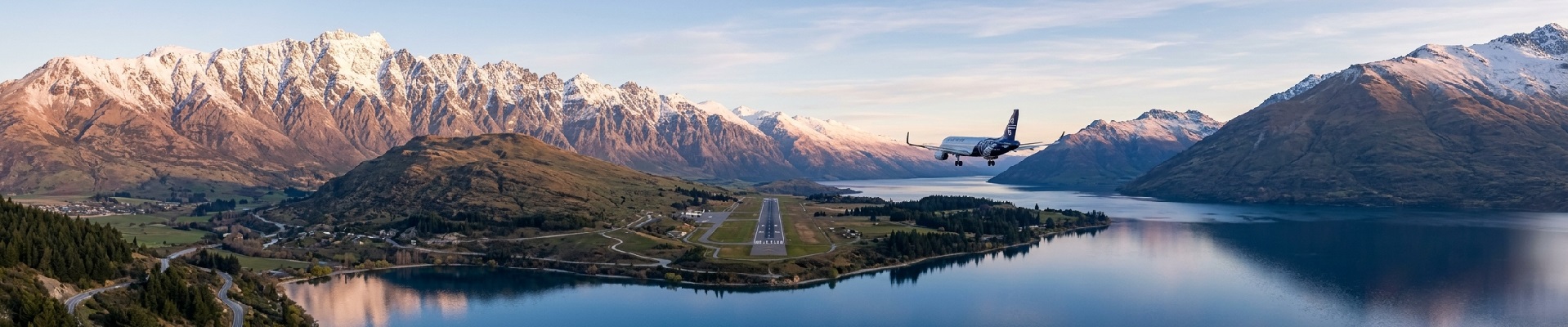
Queenstown offers one of the most spectacular approaches in the country. The aircraft descends through a valley beside the Remarkables, with Lake Wakatipu stretching below. The approach demands special pilot training, especially in difficult weather.
Direct flights arrive from several Australian cities, and domestic services connect Queenstown with Auckland, Wellington and Christchurch. Evening arrivals are now routine, though the airport is closed overnight. Rental desks, local buses and taxis wait just outside, and the ski fields, the wineries of Central Otago and the mountains around Glenorchy and Wanaka are all within easy reach.
Regional Airports
Smaller airfields open up the rest of the country, many of them served by Air New Zealand turboprops. Nelson gives access to Abel Tasman National Park and its sheltered beaches. Blenheim serves the Marlborough vineyards and the Sounds, and Napier brings you into the wine country of Hawke's Bay, close to its Art Deco town centre. Rotorua sits among geothermal valleys, geysers and hot springs. Hokitika is the gateway to the wild West Coast, with glacier country farther south. Dunedin lies at the base of the Otago Peninsula, where royal albatross nest on the headland and with luck you can watch rare hoiho penguins come ashore at dusk.
Departures are fewer here, and many trips involve a change of aircraft in Auckland, Wellington or Christchurch. Domestic fares are not always cheap and tend to rise close to departure, so book early once the route is fixed.
Before You Fly
Citizens of visa waiver countries, including the United Kingdom, the United States and much of Europe, need a New Zealand Electronic Travel Authority (NZeTA) before departure. Most eligible visitors also pay the International Visitor Conservation and Tourism Levy when applying. Processing can take a few days, so apply early. Many nationalities are outside the waiver list and need a full visitor visa in advance. Australian citizens travelling on Australian passports need neither.
Even passengers only changing planes in Auckland may need an NZeTA or a transit visa. Auckland is the only airport in the country with airside international transit, so a connection anywhere else means full entry. The rules change from time to time, so check Immigration New Zealand before booking.
New Zealand guards its islands closely. All arriving passengers complete a New Zealand Traveller Declaration and must declare food, plants, animal products, used hiking boots, camping gear and anything else that might carry soil or seeds. Undeclared items bring an instant fine.
Magelline Perspective
Auckland suits travellers starting in the North Island or arriving on the long nonstop flights from North America and the Gulf. Those heading straight for the mountains and lakes of the South Island usually do better landing in Christchurch, especially with a connection through Singapore. From Australia, Queenstown puts you among the peaks soon after arrival. Wellington works for a city stay or as the crossing point between the islands.
The best plan often uses two gateways. Fly into one island and out of the other, and leave some slack for weather and connections along the way. The long flight in cannot be avoided. Everything after it can be short.