
 Armenian
 German
 Spanish

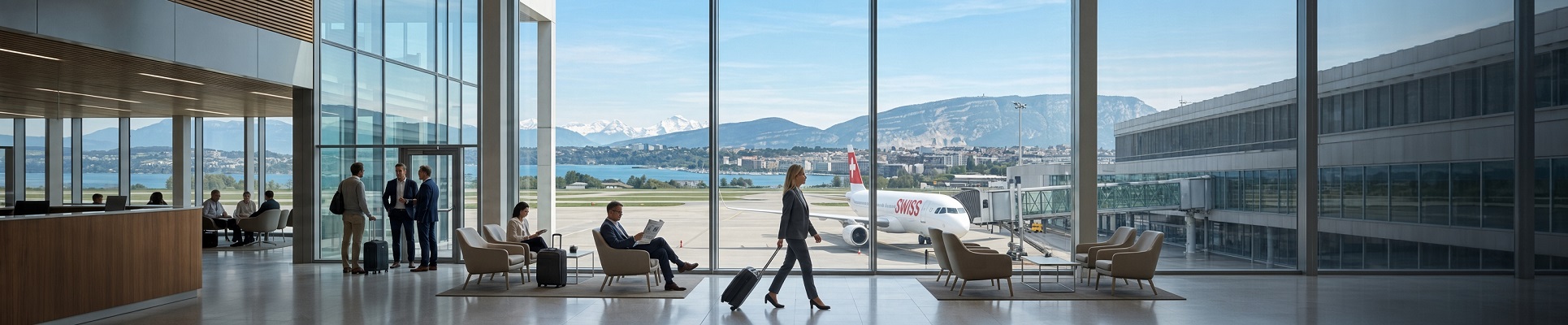 Geneva Airport
You land at an airport sitting on Swiss soil with France along its northern edge. Some approaches come in over the lake. Some do not. When runway 22 is in use, water fills the window for a long time. The Alps sit behind that, though they are not the first thing you see.
easyJet bases aircraft here, which explains why so many short European flights start and end at Geneva Airport (GVA). SWISS treats Geneva as its second city after Zurich, offering European links and a few long-haul flights like New York. Other airlines call here without keeping a fleet.
Geneva feels diplomatic. People move with purpose and without hurry. The building stays functional. Shops and cafes exist, but they do not run the place.
Movements
From runway to bags takes about thirty minutes when traffic is light. After a long flight or on a busy morning, it takes longer. Border control stays calm and customs feels straightforward.
The station sits right under the terminal. You do not need to go into town first. Many InterCity and InterRegio trains start at Genève Aéroport, reaching Cornavin seven minutes later. Trains toward the city run several times an hour until around midnight. A Unireso zone 10 ticket covers that hop. If you stay at a hotel, hostel, or campsite in Geneva, your host provides a free digital Geneva Transport Card covering your airport ride and all city public transit during your stay.
Viewpoint
On some arrivals, you see water the whole way in, specifically on the Runway 22 approach. On departure you might see it again. That view is real, though not guaranteed. Sit by a window on the correct side and check which runway is active.
Cornavin does not open directly onto the shore. From the station you walk down the hill or take a short tram. The lake sits about ten to twelve minutes away. The local geography still does more for your arrival than the terminal design.
Passenger Flow
Geneva operates at roughly half the passenger volume of Zurich. Far fewer transit connections pass through, which you notice immediately in the halls. Departure lounges offer plenty of seats, and boarding runs quieter than at a massive international hub.
This setup works if Geneva is your destination. It helps less if you need a tight long-haul connection. Zurich offers more flight banks and more options to recover from a delay.
Network
The airport avoids trying to be a major hub. It serves the city and the western region. The French sector exists so traffic to and from France can move without passing through full Swiss customs. Most travellers use the Swiss side, which opens directly to trains, trams, buses, and the motorway.
From these platforms, the country opens into natural travel corridors:
Lake Geneva and Simplon: Airport, Geneva, Lausanne (45 to 50 min), Montreux (1 h 15), Sion (2 h), Visp (2 h 30), and Brig. Zermatt requires a change at Visp onto the Matterhorn Gotthard Bahn (total 3 h 15 to 3 h 45). Zermatt remains car-free.
Mittelland: Lausanne, Fribourg, Bern (2 h), Zürich (2 h 45 to 3 h), and St. Gallen. Bern serves as the hinge for Interlaken.
Bernese Oberland: Bern, Thun, Spiez, and Interlaken West or Ost. From Interlaken Ost, you branch to Grindelwald, Lauterbrunnen, Wengen, and Jungfraujoch on private mountain railways.
Centre and South: Zürich or Lucerne toward the Gotthard, Lugano, and Italy. Lucerne to Interlaken offers the slow scenic route.
France: Léman Express and TGV Lyria trains leave from Cornavin rather than the airport platforms.
Winter Ski Connections: In winter, a weekend Verbier Express runs directly from the airport to Le Châble for cable car transfers up to Verbier.
Tickets are available in the SBB app. Point to point tickets remain valid on any train that day along that route unless locked to a specific saver fare. For simple trips, buy single tickets. If looping several cities, boats, and transit lines, a Swiss Travel Pass works best. For longer stays involving mountain lifts, a Half Fare Card often costs less. Swiss Travel Passes cover SBB and the Visp to Zermatt MGB train. Normal IC and IR trains do not require seat reservations, though they are mandatory on Glacier Express, Bernina Express, and GoldenPass Express panorama seats.
Magelline Perspective
If night one centres on the lake or the Valais, land here. If night one lands you in Lucerne, Interlaken, or Zürich, arriving in Zürich means spending less time on a train after a long flight.
When you leave, the airport steps aside. The useful parts are the seven-minute train, the lake view when the runway permits, and the fact that western Switzerland starts right below the terminal. That accomplishes enough.