
 Armenian
 German
 Spanish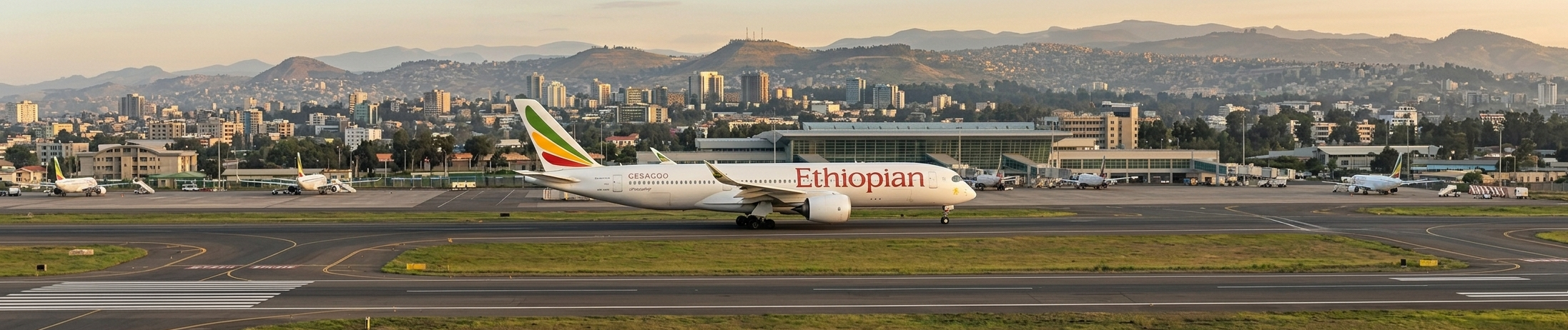
Ethiopia is building its future in the sky.
The wheels turn. The engines roar. And from the Horn of Africa, the world grows smaller and more wondrous with every departure. A new network now carries the nation toward the future through runways, terminals, and skies alive with possibility.
In Ethiopia, an airport is never just concrete and steel. It is a nation's promise, the first impression pressed into the palm of every arriving stranger, and the last whisper of home for every departing soul. In the twenty-first century, the quality of a country's aviation infrastructure speaks louder than any diplomatic communiqué. It signals ambition, connectivity, and the audacity to imagine oneself at the centre of the world's routes. Whether you are arriving to discover its historic churches and tribal cultures, to connect onward across Africa, or to experience the energy of Addis Ababa, Ethiopia's airports serve not merely as entry points, but as the first chapter of a journey unlike any other.
From its flagship international gateway in the capital to a rapidly expanding web of regional and domestic airports, Ethiopia's air transport network reflects the country's character: bold, forward-looking, and deeply connected to the wider world. Here, the ambition of a rising nation is felt the moment the wheels touch the tarmac.
Ethiopia's airports are recognised for their role as continental connectors. Addis Ababa Bole International Airport (ADD) is one of Africa's busiest and most strategically positioned hubs, serving as the primary base for Ethiopian Airlines, the continent's largest and most awarded carrier. With flights to more than 160 domestic and international destinations across five continents, the national airline ensures that onward travel from Ethiopia is both far-reaching and well-served.
One of Ethiopia's greatest strengths lies in its vision for aviation growth. The country is currently developing Bishoftu International Airport, a landmark greenfield project designed to become the largest airport in Africa, with an initial capacity of 60 million passengers annually and a long-term plan to reach 110 million. Designed by Zaha Hadid Architects and connected to Addis Ababa by high-speed rail, this future hub represents Africa's most ambitious bet on the power of connectivity.
Dire Dawa International Airport (DIR): eastern Ethiopia's principal gateway, connecting the historic trading city of Dire Dawa and offering access to the ancient walled city of Harar.
Mekele Airport (MQX): the main hub for the Tigray region in northern Ethiopia, serving as the starting point for journeys to the dramatic Danakil Depression and the rock-hewn churches of Lalibela.
Lalibela Airport (LLI): the dedicated gateway to one of Africa's most sacred destinations, home to the extraordinary 12th-century rock-hewn churches of Lalibela, a UNESCO World Heritage Site.
Gondar Airport (GDR): serving the historical heart of the Amhara highlands, with access to the Royal Enclosure, Lake Tana, and the spectacular Simien Mountains.
For international departures, it is recommended to arrive at least two to three hours before flight time. Ethiopian Airlines operates the majority of domestic routes, making connecting flights straightforward from Addis Ababa to any regional destination. English is widely spoken at major airports and signage at Bole International is clear and traveller-friendly.
In Magelline's view, Ethiopia's airports are not simply points of transit. They are the threshold of one of the world's most rewarding travel experiences. From the moment you land in Addis Ababa, the sense of a country in confident motion is unmistakable. Step beyond the terminal doors, and Africa's most storied highlands are waiting to be explored.
