 Armenian
 German
 Spanish
Ethiopia is home to some of the most remarkable historical and natural landmarks in Africa. Across its mountains, deserts, and ancient cities, travelers encounter sites that reveal thousands of years of history and some of the continent’s most dramatic scenery. From churches carved directly into rock to volcanic landscapes that seem almost extraterrestrial, Ethiopia offers sights unlike anywhere else in the world.
For travelers searching for destinations beyond the familiar paths, these landmarks represent the essence of Ethiopia’s extraordinary heritage.
Lalibela Rock-Hewn Churches
Hidden high in Ethiopia’s northern highlands lies one of the most extraordinary religious complexes ever created.
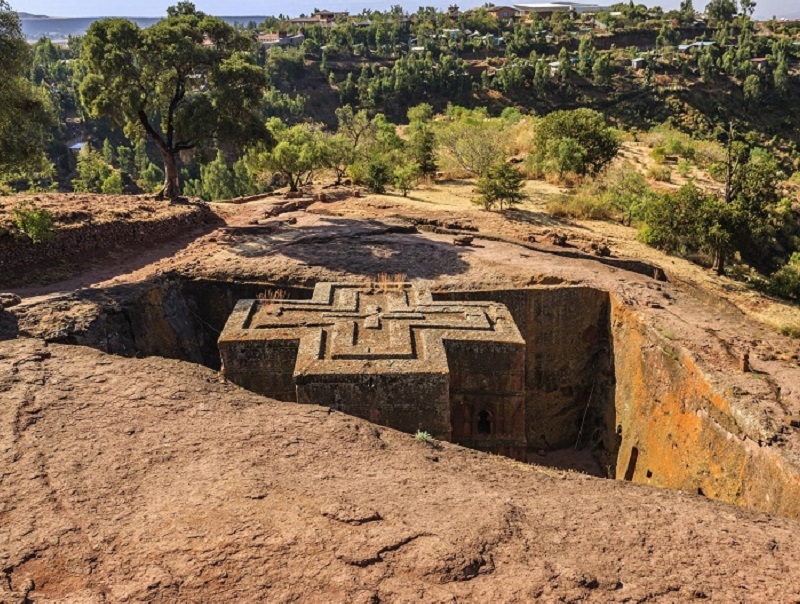
The churches of Lalibela were carved directly into solid volcanic rock during the 12th and 13th centuries. Instead of building upward, artisans carved entire churches downward into the earth, forming sacred spaces connected by tunnels and narrow passageways. The most famous of these structures is Bete Giyorgis, a perfectly shaped cross carved into the rock. Seen from above, the church appears as though it has been placed into the ground rather than carved from it.
Today, Lalibela remains an active pilgrimage site and one of the most iconic religious landmarks in Africa.
Simien Mountains National Park
Often described as the Roof of Africa, the Simien Mountains contain some of the continent’s most dramatic landscapes.
Towering escarpments drop thousands of meters into deep valleys, while jagged peaks rise above rolling highland plateaus. The scenery has often been compared to the Grand Canyon for its scale and beauty.
The park is also famous for its wildlife. Visitors may encounter gelada monkeys, large troops of primates known for their distinctive red chest patches. The rare Walia ibex and the endangered Ethiopian wolf also inhabit these mountains.
For nature lovers and hikers, the Simien Mountains offer one of Africa’s most unforgettable trekking experiences.
Aksum Obelisks
The historic city of Aksum was once the capital of one of the most powerful ancient kingdoms in Africa. At its peak nearly two thousand years ago, the Kingdom of Aksum controlled major trade routes linking Africa, Arabia, and the Mediterranean.
Today, the city is famous for its enormous stone obelisks, known as stelae. Some of these towering monuments reach heights of more than 20 meters and were carved from single blocks of granite. These impressive structures served as royal markers for ancient tombs and remain powerful symbols of Ethiopia’s ancient civilisation.
Danakil Depression
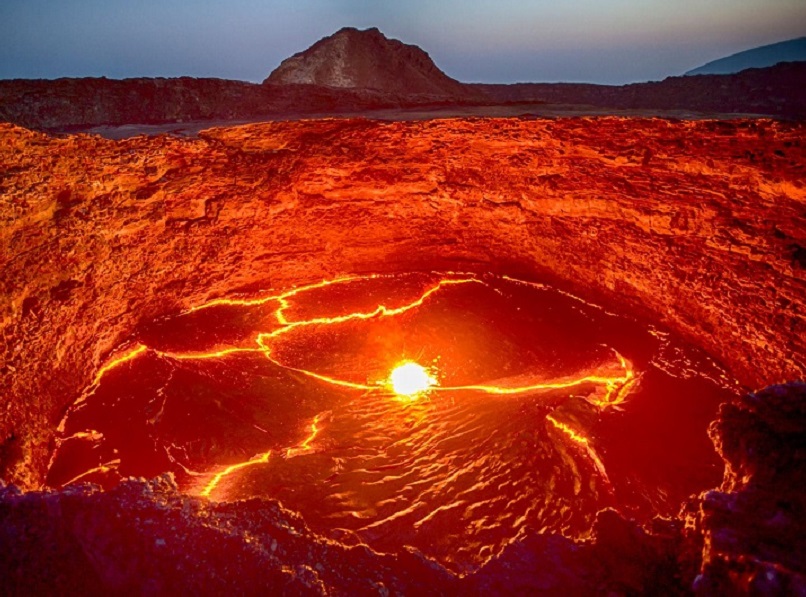
Few landscapes on Earth appear as surreal as the Danakil Depression. Located in northeastern Ethiopia, this region lies far below sea level and is considered one of the hottest places on the planet. The landscape is filled with brightly colored sulfur fields, bubbling geothermal pools, salt plains, and active volcanoes such as Erta Ale, which contains one of the world’s few permanent lava lakes.
Despite the extreme climate, the Afar people have traveled these deserts for centuries, transporting salt blocks across the region by camel caravans.
For adventurous travelers, the Danakil Depression offers one of the most unique landscapes on Earth.
Magelline Perspective
Ethiopia is not a destination that reveals itself quickly. Its beauty lies in depth — in the layers of history carved into its mountains, the traditions preserved within its churches and villages, and the landscapes that seem untouched by time. Traveling here means encountering one of the world’s oldest civilisations while standing among some of Africa’s most dramatic natural wonders.
In Magelline’s eyes, Ethiopia is a place where history, culture, and landscape merge into a journey that feels both timeless and profoundly human.