
 Armenian
 German
 Spanish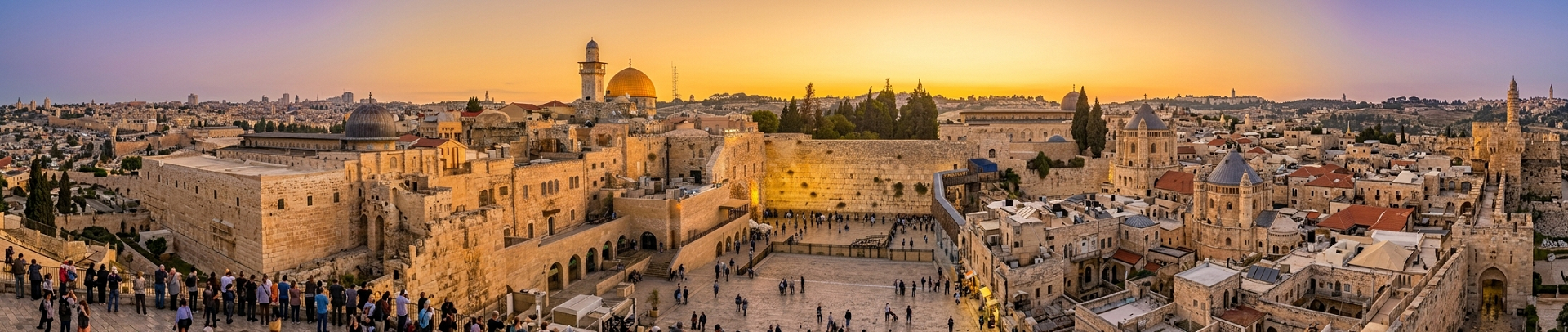
The call to prayer drifting over rooftops at dusk. The weight of salt water holding a body afloat without effort, in a sea where almost nothing else can live.
Israel does not offer a single landscape. It offers a sequence of them, each one different enough that arriving in the next feels like crossing into another country entirely.
The Old City of Jerusalem
Within ancient walls, four quarters, Jewish, Christian, Armenian, and Muslim, sit within a few minutes' walk of one another. The Western Wall draws prayers at all hours, narrow stone lanes lead toward courtyards layered with thousands of years of history, and the overlapping sounds of bells, prayers, and market vendors create something found nowhere else on the planet.
Come early. The light on the stone walls at sunrise is reason enough.
The Dead Sea
At over four hundred metres below sea level, the Dead Sea is the lowest point on earth and one of the saltiest bodies of water anywhere. Floating here feels less like swimming than being held, and the surrounding mineral mud has drawn visitors for its therapeutic reputation since antiquity.
The desert cliffs framing the shoreline only add to the sense of having arrived somewhere otherworldly.
Masada
Rising abruptly from the desert floor above the Dead Sea, Masada was once a mountaintop fortress and palace complex. A cable car now carries most visitors to the summit, though the original Snake Path remains for those willing to climb before dawn.
The view across the desert and the Dead Sea from the top explains why this site was chosen in the first place.
Tel Aviv
Tel Aviv trades ancient stone for clean modern lines. The White City holds the largest concentration of Bauhaus buildings anywhere in the world, recognized by UNESCO for its architectural unity. Beyond the architecture, the city's long beachfront promenade, café culture, and nightlife give it a rhythm closer to a Mediterranean capital than a historic one.
The Sea of Galilee and Nazareth
Israel's largest freshwater lake sits surrounded by green hills and small towns that move at a noticeably slower pace than the coast. Boat rides across the water, lakeside fish restaurants, and the nearby town of Nazareth, with its layered Christian heritage, make this region one of the country's most peaceful corners.
The Baha'i Gardens (Haifa)
Cascading down the slope of Mount Carmel in nineteen perfectly manicured terraces, the Baha'i Gardens are among the most photographed sights in the country. The view stretches from the gardens themselves down to Haifa's port and the Mediterranean beyond.
Eilat and the Red Sea
At Israel's southern tip, Eilat opens onto coral reefs that sit remarkably close to shore. The Red Sea here stays warm year round, and the underwater visibility ranks among the best in the region, drawing divers and snorkelers to a coastline that feels worlds away from Jerusalem's stone alleys.
Caesarea
Once a grand Roman port city, Caesarea's ruins now sit directly on the Mediterranean shoreline. Columns, an amphitheater, and a restored harbor make it one of the most atmospheric archaeological sites in the country, particularly at sunset when the stone catches the last light over the sea.
Why Israel?
No single sight defines this country. A market alley in Jerusalem, a float in the Dead Sea, a sunset over Caesarea's ruins: each belongs to a different Israel, and all of them are real at once. That contrast, more than any individual landmark, is what travelers carry home.
Magelline Perspective
Most countries ask you to pick a theme for your trip: history, nature, faith, or the coast. Israel refuses the choice. A single week here can move from a sunrise prayer at the Western Wall to a sunset dive on a Red Sea reef, and the distance between them is shorter than it sounds. With Magelline, building that itinerary is the easy part.
