 Armenian
 German
 Spanish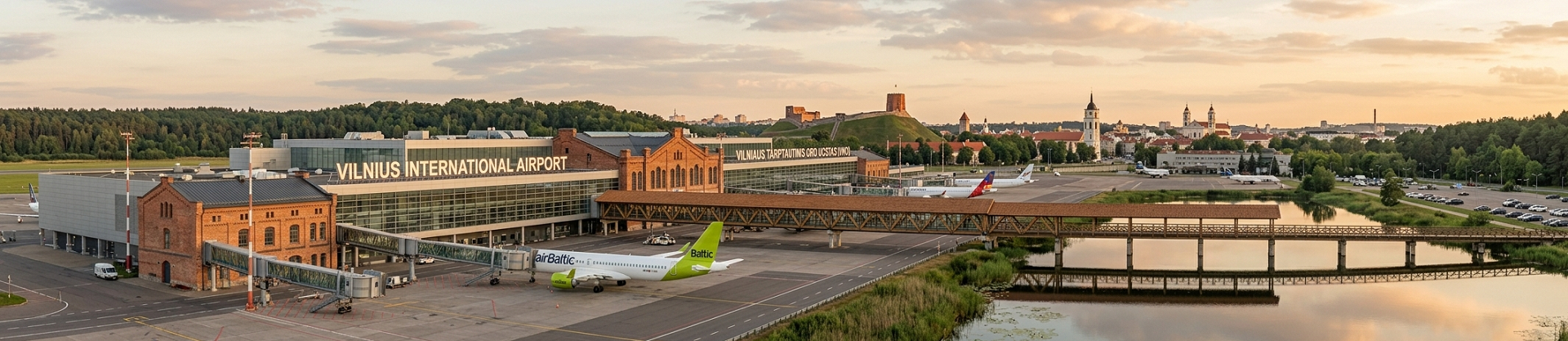
To arrive in Lithuania by air is to watch a green country unfold beneath the wing. The largest and southernmost of the Baltic states reveals itself slowly: a plain of forests and lakes stitched together by slow rivers, villages gathered around white church towers, and then, on final approach to the capital, a skyline of baroque domes and spires rising from a valley as if the city had grown there like the woods around it.
Lithuania has always understood arrival. This was once the seat of a grand duchy whose roads reached from the Baltic to the Black Sea, and something of that old confidence survives in the way the country receives its guests. Today the journeys begin in the sky, and they lead to remarkable places: the courtyards and bell towers of Vilnius, the bold modernist streets of Kaunas, the island castle at Trakai, and a western shore where amber still washes up on the sand and the dunes of the Curonian Spit stand like a desert conjured beside the sea.
The country's aviation map has a pleasing logic to it. One principal gateway serves the capital in the southeast, a second anchors the country's heartland, and a third waits by the Baltic, steps from the beach. A fourth runway in the north belongs mostly to the realm of legend and thunder. Together they open every door Lithuania has.
Vilnius Airport (VNO)
The main gateway to Lithuania carries the name of ?iurlionis, the painter and composer whose dreamlike visions still define the national imagination, and something is fitting in that. Arrival here feels composed rather than processed. The airport sits just south of the capital, so close that the descent offers a private viewing of the old town's domes, and the journey from runway to cobblestones can be measured in minutes rather than hours. Its departure boards reach across Europe, from the Nordic capitals to the Mediterranean, carried by a mix of national and international airlines. For most travelers, this is where Lithuania begins: a short drive from baggage hall to the largest baroque old town in northern Europe, where bells ring the hours and café tables spill into courtyards that have heard six centuries of conversation.
Kaunas Airport (KUN)
An hour and a half west of the capital, Kaunas keeps Lithuania's second gateway, and it wears its role with the quiet pride typical of the city itself. This is the airport of the temporary capital, the city that ran the country between the wars and built itself a legacy of modernist architecture so distinctive it is now celebrated worldwide. The airport is a favourite of travelers who like their fares low and their arrivals swift, with routes threading across Europe and a terminal small enough that you are through it almost before you have finished your thought. Beyond the doors wait the confident avenue of Laisv?s al?ja, the merging of two rivers beneath a medieval castle, and a café culture that considers itself, with some justification, the soul of the country.
Palanga Airport (PLQ)
On the western edge of Lithuania, where the pine forest finally gives way to the Baltic, lies the most atmospheric arrival of them all. Palanga Airport serves the country's summer capital, a seaside town of wooden villas, botanical gardens and a pier that walks straight out into the sunset. The runway sits minutes from the beach, and the connections it offers make the entire coast feel suddenly close: the port city of Klaip?da with its old German merchant houses, the fishing villages of the Curonian Spit, and the amber galleries where the Baltic's golden stone is polished into memory. Seasonal and year-round routes link Palanga with northern Europe, and travelers who land here often say the holiday begins on the tarmac, with salt already in the air.
Šiauliai Airport (SQQ)
Far in the north, near the city of the Hill of Crosses, stretches one of the longest runways in the Baltics, a strip of concrete with a story larger than any timetable. Šiauliai is a place of aviation legend, its airfield long entrusted with guarding the Baltic sky, and the thunder overhead is more often the sound of allied jets than of holiday charters. Civilian flights are rare visitors here, yet the airport remains a presence in the national story, and the city it neighbours rewards the traveler who arrives by road: a place of pilgrimage where a hillside of crosses stands against the wind, one of the most haunting sights in the Baltics.
Magelline Perspective
An airport is never merely a runway and a roof. It is the first sentence of the journey, and Lithuania writes beautiful first sentences: a descent over baroque domes, a terminal beside the dunes, the scent of pine as the doors open. Whether your story begins in Vilnius, Kaunas or Palanga, it will lead somewhere unforgettable, to candlelit cellars and river valleys, to modernist facades and amber shores.
Let Magelline turn that first page for you. Explore our dedicated guides to each of Lithuania's airports, discover the routes and carriers that will bring you here, and begin planning the Baltic journey you have been dreaming of at Magelline.com.
