 Armenian
 German
 Spanish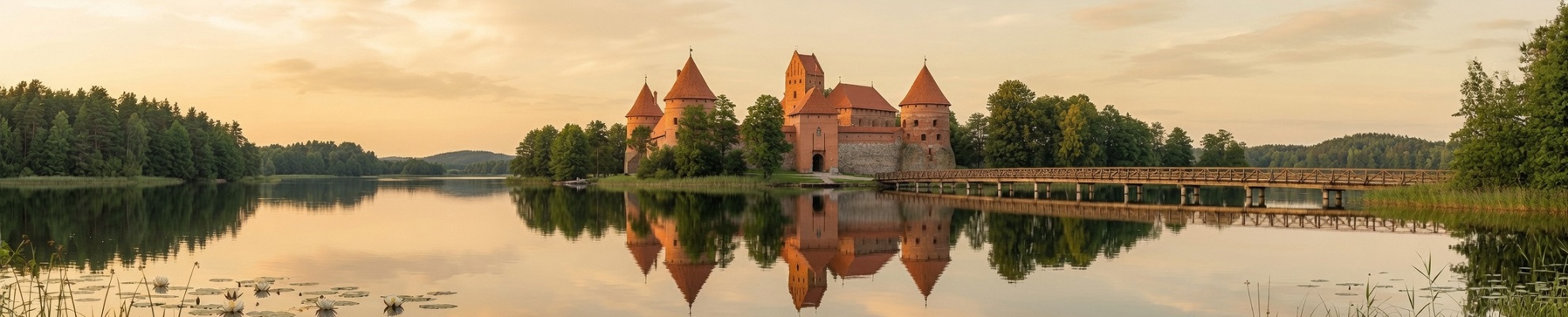
Lithuania rewards the curious. The largest of the Baltic states hides a capital of golden baroque churches, a fairytale castle rising from a lake, a hill blanketed in thousands of crosses, and a ribbon of sand dunes that Thomas Mann once called home. Distances are short, prices are gentle, and the crowds that fill other European capitals have not yet arrived. Here is where to begin.
Vilnius Old Town
Few European capitals feel this intimate. Vilnius Old Town, protected by UNESCO, is one of the largest surviving medieval quarters on the continent, yet it unfolds as a maze of cobbled lanes, hidden courtyards, and amber workshops. More than a thousand buildings crowd into its narrow streets, and the skyline bristles with church towers in every style from Gothic to baroque. Start at Cathedral Square, where the neoclassical cathedral gleams white against the sky, then wander south along Pilies Street toward the Gates of Dawn, a chapel whose golden icon of the Virgin Mary draws pilgrims from across Eastern Europe. Do not miss St. Anne's Church, a flamboyant Gothic masterpiece of thirty three different kinds of brick. Legend claims Napoleon wanted to carry it back to Paris in the palm of his hand.
Gediminas Tower
Climb the hill above Cathedral Square and Vilnius spreads out beneath you in a sea of red roofs and green domes. Gediminas Tower is all that remains of the Upper Castle built in the fourteenth century, when Grand Duke Gediminas dreamed, so the story goes, of an iron wolf howling on this very hill. The dream commanded him to found a city here. Inside the tower, a small museum traces the history of the castle and the Baltic Way, the human chain of two million people that stretched from Vilnius to Tallinn in 1989. Come at sunset, when the light turns the old town to honey.
Užupis
Cross a small bridge over the Vilnel? River and you enter another country. Užupis, a bohemian district of artists and dreamers, declared itself an independent republic in 1997, complete with its own constitution, president, and an army of about a dozen soldiers. The constitution, displayed on mirrored plaques in dozens of languages, guarantees every person the right to be happy, the right to be unhappy, and every dog the right to be a dog. Galleries, cafes, and street art fill the riverbanks. It is whimsical, yes, but also a genuine celebration of the freedom Lithuania fought so hard to regain.
Trakai Island Castle
Half an hour west of Vilnius, a castle of rose colored brick rises from an island in Lake Galv?, joined to the shore by a long wooden footbridge. Trakai was the medieval capital of the Grand Duchy of Lithuania, and its restored fortress now houses a museum of armor, coins, and courtly treasures. The setting is the real spectacle: water on every side, sailboats drifting past the towers, forests ringing the lake. Before you leave, try kibinai, the crescent shaped pastries of the Karaim community that has lived in Trakai since the fourteenth century.
Hill of Crosses
Near the northern city of Šiauliai stands one of the most haunting places in Europe. On a small mound in open farmland, pilgrims have planted crosses since the nineteenth century: wooden crosses, iron crosses, crosses hung with rosaries, crosses the size of a thumbnail and crosses taller than a house. Soviet authorities bulldozed the hill three times. Each time, the crosses returned overnight. Today more than one hundred thousand of them stand together, creaking softly in the wind, a testament to faith and quiet defiance that no visitor forgets.
Curonian Spit
A sliver of sand nearly one hundred kilometers long separates the Curonian Lagoon from the Baltic Sea, and its Lithuanian half is a national park of pine forest, fishing villages, and some of the highest drifting dunes in Europe. From the resort town of Nida, climb the Parnidis Dune for a view of pure Sahara on one side and cold blue sea on the other. Weathered wooden cottages with carved gables line the lagoon, among them the summer house where Thomas Mann wrote in the early 1930s. Ferries from Klaip?da make the crossing in minutes.
Kaunas
Lithuania's second city wears its history boldly. The old town huddles at the meeting of two rivers beneath a Gothic castle, while the newer avenues showcase one of the finest collections of interwar modernist architecture in Europe, recognized by UNESCO in 2023. Kaunas served as the temporary capital between the wars, and the optimism of that era still shows in its streamlined facades. Visit the M. K. ?iurlionis Museum, devoted to the painter and composer whose dreamlike canvases feel like national anthems in color.
In Magelline's Eyes
Lithuania is a country that kept its soul through every occupation and never lost its sense of wonder. It gives you baroque splendor in the morning, wild dunes by afternoon, and a hill of whispering crosses that stays with you long after the flight home. Go now, while it still feels like a secret.
