 Armenian
 German
 Spanish
Ask ten travellers about Mexico and you will hear the same few names. They are famous for good reason, but the country has a lot more to show than its headline ruins and beaches. Some places here are much loved by Mexicans and not so well known abroad. Others take real effort to reach, and a couple are just plain strange.
Mexico City, Away from the Zócalo
The National Museum of Anthropology in Chapultepec Park could easily take a whole day, but most visitors end up standing longest in front of the Sun Stone. It is a carved basalt disc of around 24 tonnes, usually called the Aztec calendar. Scholars are still not sure that is what it was.
Frida Kahlo was born in the Casa Azul in Coyoacán, and she died there too. The cobalt walls are hard to miss. Inside are her brushes, her corsets and the wheelchair she painted from in her last years. Give yourself time for the neighbourhood around it, with its cobbled lanes and coffee houses that have been open for decades.
Xochimilco is a trip of its own, an hour or more south of the centre depending on traffic. City families come out here on weekends, and it feels more like a country town than part of the capital. The canals are what is left of the great lake that once surrounded Tenochtitlan, and farmers still grow flowers and vegetables on chinampas, the old floating gardens. You hire a painted boat called a trajinera, a mariachi band pulls alongside for a song or two, and somebody always paddles up selling grilled corn.
Lost Cities in the South
The Zapotecs started building Monte Albán around 500 BC, and they began by cutting the top off a mountain. The city is still up there above Oaxaca with its plazas, temples and ball court, and the valley far below.
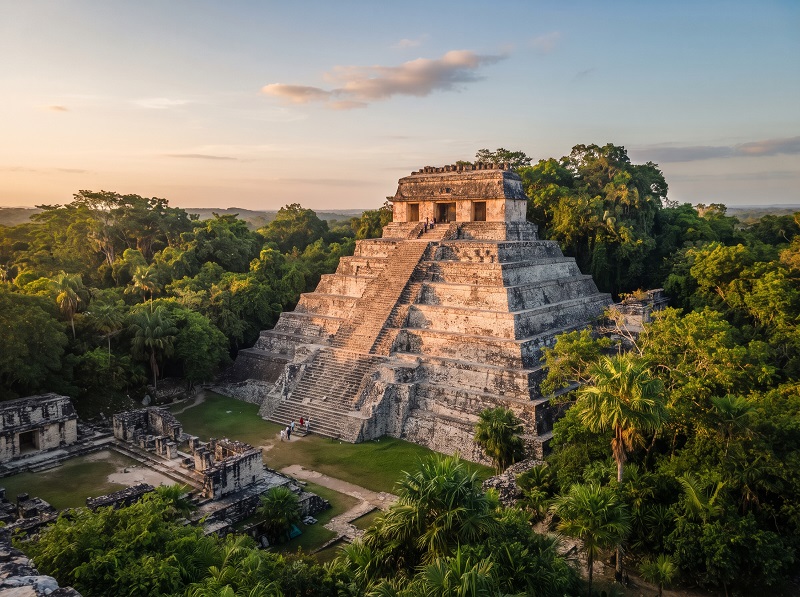
Calakmul takes more effort. It sits in southern Campeche near the Guatemalan border, inside one of the largest biosphere reserves in Mexico, and the last stretch is a slow road through forest. In its day it was among the most powerful Maya kingdoms and a rival of Tikal. Climb the main pyramid if it is open. From the top there is forest in every direction, and you will probably hear howler monkeys before you see anything else.
Water in Strange Forms
Hierve el Agua is a couple of hours by road from Oaxaca city, up in the mountains. The name means "the water boils," although the springs are cool and only bubble. Over thousands of years the mineral water running down the cliff has left white rock that looks like a frozen waterfall. There are natural pools right on the edge, and you can swim in them.
People call Bacalar Lagoon, near the Belize border, the Lake of Seven Colours, and on a clear morning you can see why. Stromatolites grow along its shores, rock formations built by some of the oldest life on Earth. They are fragile, so please do not stand on them.
The Sumidero Canyon in Chiapas has walls close to a kilometre high. Boats leave from Chiapa de Corzo and run along the Grijalva River past crocodiles, spider monkeys and a mossy waterfall known as the Christmas Tree.
The Surreal Heart of the Country
Edward James was a British poet with a large fortune, and he spent much of it supporting the surrealists. From the 1960s until his death in 1984 he built Las Pozas in the jungle near Xilitla, in San Luis Potosí. It is a garden of concrete columns that support nothing and staircases that end in mid air, with waterfalls and pools running between them.
About an hour from Xilitla is the Sótano de las Golondrinas, a pit more than 300 metres deep. Get there before sunrise. Thousands of swifts fly out of it in a slow spiral, and in the evening they come back and dive straight in.
Real de Catorce, up in the high desert of the same state, was a busy silver mining town until the mines ran out. You get in through a single lane tunnel more than two kilometres long. It is quiet now, with stone streets and a church where people leave candles. The desert around it is Wirikuta, sacred to the Wixárika people, who still come here on pilgrimage.
Magelline Perspectives
The famous ruins and beaches will always be worth the trip. If you have room for one extra stop, take it from this page. Most of these places need a longer drive or an early start, and that is usually the part of the journey people talk about when they get home.