 Armenian
 German
 Spanish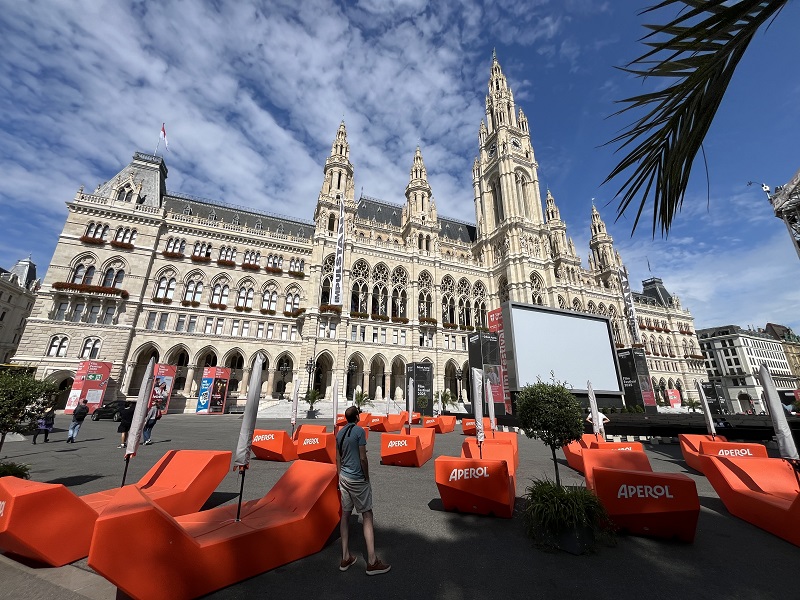

 Vienna City Hall
The Rathaus rises from the Ringstrasse like a cathedral that wandered into civic life. Vienna's City Hall is the grandest secular expression of Gothic Revival in Central Europe, and few first-time visitors expect a town hall to look quite so much like a place of pilgrimage. That was precisely the intention.
When Vienna tore down its medieval walls in the mid-19th century, the freed land became a stage for a new imperial boulevard. On a former parade ground the city commissioned a fresh seat of government, and the German architect Friedrich von Schmidt, once master builder of Cologne Cathedral, won the competition. Between 1872 and 1883 he raised a building that borrowed the language of the great town halls of Flanders: pointed arches, delicate stone tracery, soaring spires and a facade carved with statues. The choice was daring. The imperial court favoured Renaissance and Baroque, yet Schmidt pushed his vision through, and the result reads like northern Gothic transplanted south.
Its scale still astonishes. Some 30 million bricks and more than 40,000 cubic metres of stone went into the complex, which hides seven inner courtyards and over 1,500 rooms behind its long front. The central tower climbs to 97.9 metres, and behind that figure lies a wonderful piece of Viennese cunning. Emperor Franz Joseph had decreed that no secular building should overtop the 99-metre towers of the nearby Votivkirche. Schmidt obeyed to the letter, then crowned his tower with the Rathausmann, an armoured iron knight of 3.4 metres who, banner in hand, quietly lifts the whole composition past 100 metres.
For well over a century the building has been the beating heart of the city's civic life. It remains the office of the mayor and the meeting place of the municipal council, and because Vienna is at once a city and one of Austria's federal states, it also houses the regional government. Decisions that shape daily Viennese life are still taken behind these Gothic windows.
Travellers, though, come for what the Rathaus offers beyond politics. Free guided tours lead through ceremonial halls, the finest of which is the Festsaal, a ballroom 71 metres long that hosts Vienna's glittering season of balls. The arcaded courtyard, among the largest in Europe, fills with music and open-air cinema each summer. The energetic can climb 331 steps up two spiral staircases to stand beside the tower and survey the rooftops of the old town.
The square in front, Rathausplatz, is a festival in its own right. In December, the Christkindlmarkt wraps it in the scent of mulled wine and roasted almonds. Summer brings a film festival with food stalls from around the world. In winter, the whole space freezes into the Wiener Eistraum, a dreamlike maze of ice paths for skaters gliding beneath the illuminated spires.
In Magelline's Eyes
The Rathaus is Vienna in miniature: serious about governance, yet endlessly in love with celebration. Come for the architecture and stay for the seasons, because there is scarcely a month when this Gothic giant is not hosting the city at play.