
 Armenian
 German
 Spanish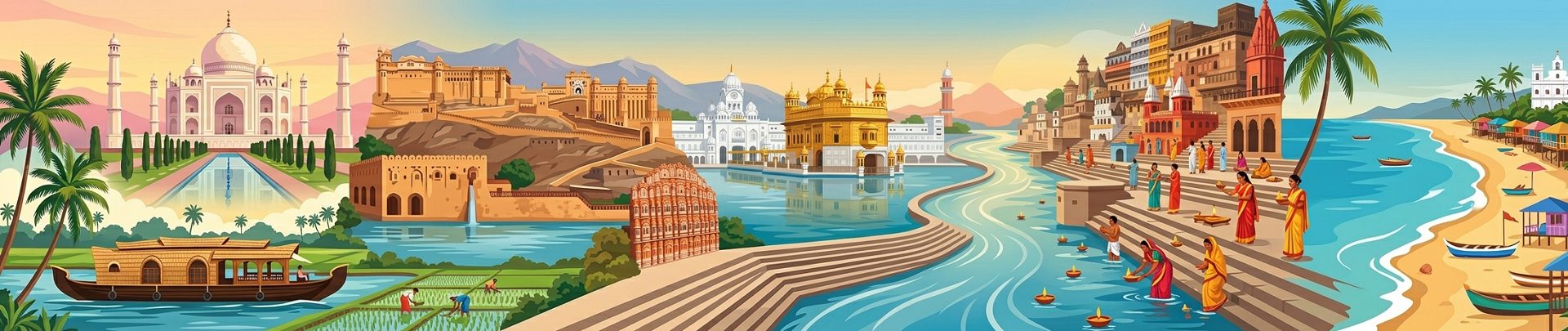
Among the most celebrated sights in India is the Taj Mahal in Agra, a marble mausoleum built in the seventeenth century by Emperor Shah Jahan in memory of his wife, Mumtaz Mahal. Its perfectly symmetrical domes and minarets, set against gardens and reflecting pools, have made it one of the most recognised monuments on earth.
Visiting at sunrise is highly recommended, when the marble takes on soft pink and golden tones, and the crowds are still thin. The monument is closed on Fridays, so travellers should plan their visit accordingly.
Amber Fort, Jaipur
Perched on a hill overlooking Maota Lake, Amber Fort is one of Rajasthan's most magnificent examples of fort architecture, combining Hindu and Mughal styles in its courtyards, halls and mirrored chambers. The Sheesh Mahal, or Hall of Mirrors, is especially striking when lit by even a single candle.
A short distance away, the City Palace and Hawa Mahal complete a full day of exploring Jaipur's royal past.
Arriving early in the morning helps avoid both the heat and the tour groups, and a guide is recommended to appreciate the symbolism behind the fort's design fully.
The Ghats of Varanasi
Stretching along the western bank of the Ganges, the ghats of Varanasi are wide stone steps where daily life and ancient ritual meet. Pilgrims bathe in the river at dawn, while in the evening, the Ganga Aarti ceremony fills the riverfront with chanting, bells and floating oil lamps.
A boat ride along the river, particularly around sunrise or sunset, offers the best perspective on the scale and atmosphere of this sacred city.
Visitors should approach the cremation ghats with sensitivity, as these remain active sites of mourning and ritual for local families.
Kerala Backwaters
In the southern state of Kerala, a network of canals, rivers and lagoons known as the backwaters runs parallel to the coast. Traditional houseboats, once used to transport rice and spices, now carry travellers slowly past paddy fields, coconut groves and small villages.
An overnight stay on a houseboat, departing from Alleppey or Kumarakom, is one of the most relaxing ways to experience rural Kerala, with fresh seafood often prepared on board.
The backwaters are best visited outside the monsoon months, when water levels and weather are most favourable for slow travel.
Golden Temple, Amritsar
The spiritual centre of Sikhism, the Golden Temple in Amritsar, is a gilded shrine set within a large pool known as the Amrit Sarovar. Open to visitors of all faiths around the clock, the temple complex also runs one of the world's largest community kitchens, serving free meals to tens of thousands of people every day.
Visiting after dark, when the temple is illuminated and reflected in the water, leaves a lasting impression. A head covering is required for all visitors, and shoes must be removed before entering.
Goa's Beaches
On India's western coast, Goa offers a string of beaches with very different characters, from the lively shores of Baga and Calangute to the quieter stretches of Palolem and Agonda in the south. Portuguese colonial influence is visible in the architecture of churches, old town houses and the cuisine, which blends Indian spices with European techniques.
The dry season from November to February offers the most comfortable weather for both beach time and exploring Goa's old quarters, such as Fontainhas in Panaji.
In Magelline's view, India's sights are rarely just monuments. The Taj Mahal is also a love story, the ghats of Varanasi are also a living ritual, and a houseboat in Kerala is also a slow afternoon among paddy fields. Seeing these places with a little context turns sightseeing into something closer to understanding.
