 Armenian
 German
 Spanish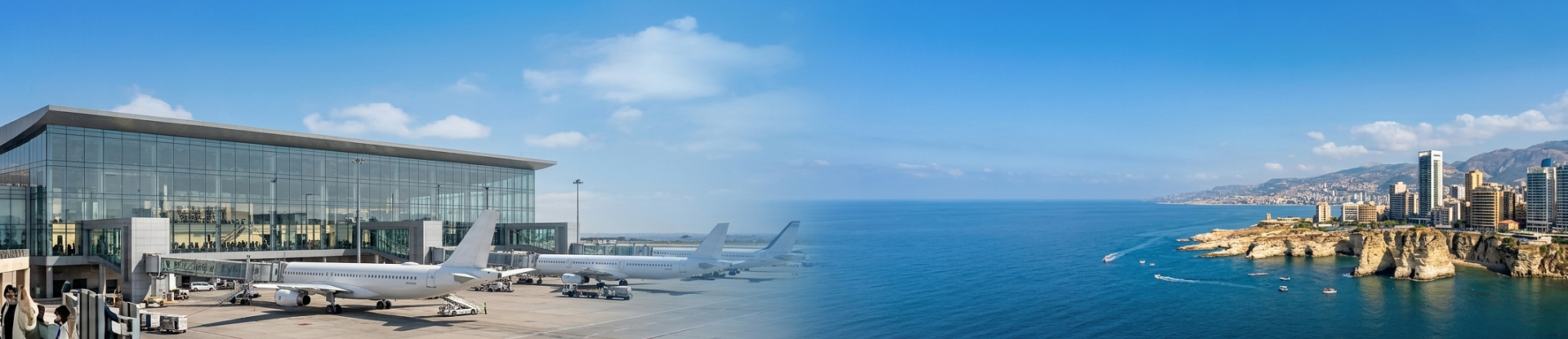
Lebanon is a country you can cross in a morning, from the salt haze of the coast to the snow line of the mountains, and almost everyone who arrives does so through a single door. That door is Beirut.
Air access here is concentrated rather than scattered. One airport carries the scheduled traffic of an entire country. A few other airfields appear on the map, but they are military sites closed to civilian traffic, so nothing on them concerns anyone holding a ticket. For the traveller this makes planning unusually simple. You fly into Beirut, and the rest of Lebanon unfolds by road.
Beirut Rafic Hariri International Airport (BEY)
Beirut Rafic Hariri International Airport lies a short distance south of the city centre, close to the shore at Khaldeh, where the runways run beside the Mediterranean and the ridge of Mount Lebanon rises behind them. The approach is among the most theatrical in the region. There is water, then a sudden band of pale apartment blocks stacked up the hillside, then the ground.
Named after a former prime minister of Lebanon, the airport is the home base of Middle East Airlines, the national carrier, whose cedar tail fins are usually the first Lebanese thing a traveller sees.
The route map leans toward the Gulf, Europe and the wider Mediterranean, shaped as much by the Lebanese abroad as by tourism. In the warm months the arrivals hall takes on the character of a family reunion, with flowers, hand painted signs and a great deal of embracing near the barriers. It is one of the more emotional airport halls anywhere, and it tells you something true about the country before you have even reached the taxi rank.
The terminal is single and legible, which means nothing inside it is ever far away. Expansion work has been continuing in stages, easing a building that has long carried more people than it was originally drawn for. Security is layered and thorough, so allow generous time on departure, particularly in summer and around holidays. Currency exchange, cafés and duty free shopping are all present, though most travellers find the city itself far more rewarding for anything they might want to carry home.
Getting into Beirut takes little time in theory and considerably longer in practice, since the coastal road carries the traffic of the whole country. Prearranged transfers and taxi counters inside the terminal are the calmest option.
Rene Mouawad Airport, Kleyate (KYE)
In the far north of the country, on the wide agricultural plain of Akkar beyond Tripoli, sits the airfield at Kleyate, known officially as Rene Mouawad Airport and long used as an air base. It is surrounded by orchards and low hills, with the sea to one side and the mountains folding away to the other.
For many years it has been discussed as a second civil gateway to Lebanon, a way of opening the north to visitors without routing them through the capital, and preparation has moved forward in stages. Treat it as a possibility on the horizon rather than a booking option. The name is still worth knowing, because anyone planning time around Tripoli, Akkar or the northern mountains currently faces the length of the country twice, and that will not always be so.
Arriving & Departure
Lebanon has no scheduled domestic flights, and it does not need them. From Beirut, the Roman columns of Byblos are under an hour away on a good day, Sidon and Tyre lie south along the coast, Tripoli anchors the north, and the temples of Baalbek sit beyond the mountain pass in the Bekaa. Everything is reachable by car, and the driving itself is part of the pleasure, since the road is never far from either water or altitude.
Arrive at the airport well before departure, keep passport and boarding documents easy to reach, and expect several checkpoints between the entrance and the gate. Once you are through, the process softens considerably.
In Magelline's view, Lebanon's aviation map is short but not simple. One airport does the work of many, and it carries not only passengers but a whole diaspora's habit of coming home.
