
 Armenian
 German
 Spanish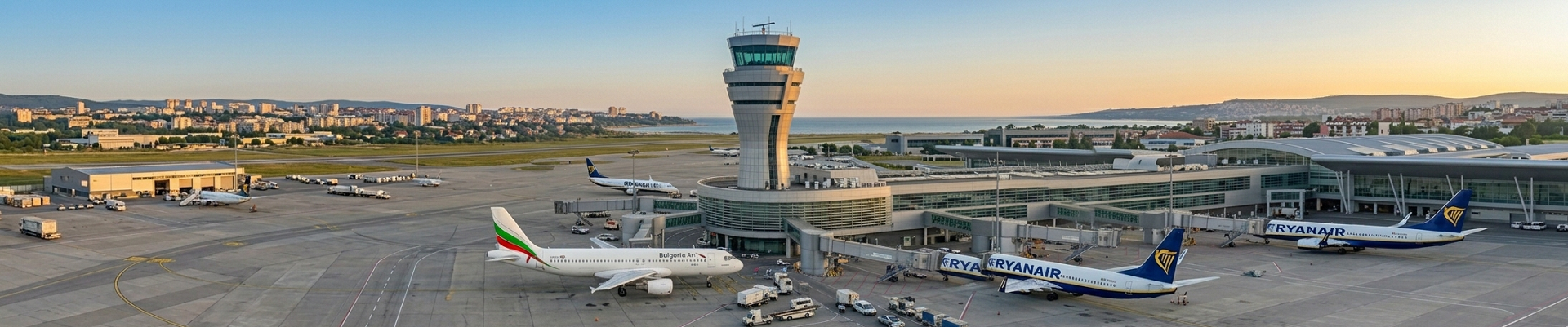
Bulgaria serves as a critical aerial bridge between Europe and Asia. The country’s airport infrastructure stands at the forefront of transformation, following years of strategic investment and modernisation. For the global traveler, Bulgaria offers a sophisticated network of gateways that blend high-capacity efficiency with a focus on passenger comfort.
Compact yet efficient, Bulgaria’s airports offer direct access to coastal resorts, mountain landscapes, and historic cities shaped by centuries of movement and exchange. For the Magelline traveler, arrival in Bulgaria feels immediate. Distances are short, transitions are smooth, and the journey from runway to destination unfolds with understated ease.
Airport Network
Bulgaria’s aviation system is built around a focused group of international airports. Rather than relying on a single dominant hub, the country distributes traffic across several key gateways — each aligned with a distinct travel purpose. This structure allows Bulgaria to remain accessible, especially during peak summer seasons when coastal tourism defines the rhythm of arrivals.
Sofia Airport (SOF)
As the primary international gateway, Sofia Airport has undergone a significant evolution under its current long-term development plan. It serves as the main operational base for the national carrier, Bulgaria Air, and acts as a central node for both full-service and low-cost international carriers.
The airport is currently transitioning toward the construction of a state-of-the-art Terminal 3. Terminal 2 has been optimised to handle increased traffic, now connecting Sofia to nearly 100 global destinations.
With enhanced duty-free zones and upgraded lounge facilities, Sofia Airport offers a seamless experience for business and leisure travelers alike.
Burgas Airport (BOJ)
Primarily serving the Southern Black Sea coast, Burgas Airport is a vital pillar for Bulgaria’s seasonal tourism. In early 2026, the airport reached a major milestone with the completion of a total runway rehabilitation, ensuring its ability to handle the world’s largest passenger aircraft.
Burgas is home to the "Gate Gardens", a unique architectural concept that represents a unique European concept of an “open terminal”, integrating outdoor green spaces into airport infrastructure. The project was implemented in parallel with a comprehensive internal functional and architectural redevelopment of Terminal 2 at both coastal airports (the project was also implemented at Varna Airport). The concept responds to the new operational requirements for terminal infrastructure resulting from the Republic of Bulgaria’s accession to the Schengen Area.
Varna Airport (VAR)
Varna Airport provides essential access to the Northern seaside resorts. It operates in tandem with Burgas to provide a smooth "maritime corridor" for millions of visitors.
Varna has expanded its direct flight network to over 60 destinations, solidifying its position as a year-round operational hub. Its modern terminal design emphasises speed and efficiency, making it one of the most traveller-friendly airports in the region.
Plovdiv Airport (PDV)
For those heading to the ski resorts of the Rhodope Mountains or the historic centre of Plovdiv, this airport offers a niche, high-efficiency alternative. It remains the preferred choice for charter flights and budget carriers seeking a direct link to Bulgaria's cultural heartland.
Magelline Travel Note
Whether you are flying into the capital for business or landing on the coast for a summer retreat, Bulgaria’s infrastructure is designed to make your arrival as pleasant as your stay. To book flights with airlines serving these airports, visit Magelline.flights, where you will find convenient flights or direct support.
