 Armenian
 German
 Spanish
To look at Egypt is to look at the very blueprint of human ambition. Across deserts, riverbanks, and coastlines, the country reveals a collection of places where light, stone, and silence come together — not as isolated landmarks, but as living environments shaped by centuries of presence.
The Grand Egyptian Museum
Standing on the Giza plateau, the GEM is the most significant cultural opening of the century. It is an architectural "modern pyramid" of glass and light. Within its halls, the complete treasures of Tutankhamun are reunited for the first time in history. But the true Magelline moment is the Grand Staircase—a vertical ascent through 5,000 years of pharaonic statuary, ending with a panoramic frame of the Great Pyramids themselves.
Saqqara
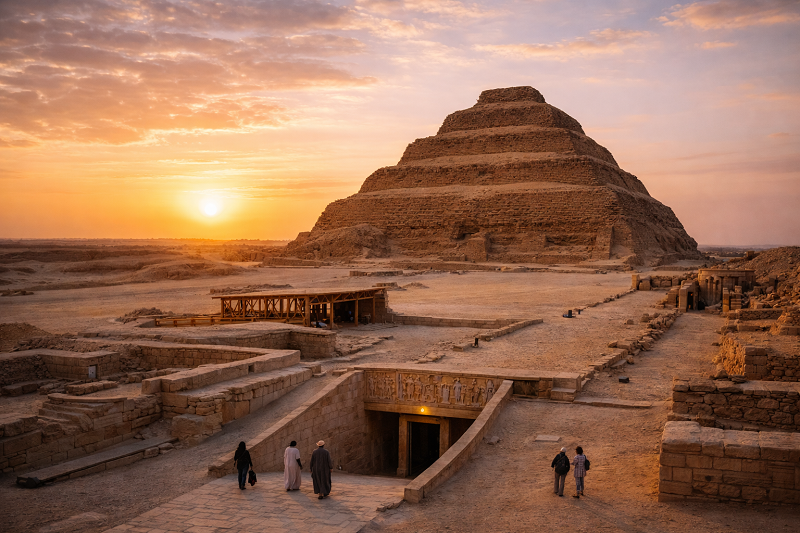
While Giza is the icon, Saqqara is the soul. Home to the Step Pyramid of Djoser, this site remains a living excavation. In recent years, the discovery of vibrant "Mega-Tombs" has transformed our understanding of the afterlife. Here, the colours on the walls remain so vivid they seem painted yesterday—a testament to the Egyptian obsession with the eternal.
Siwa Oasis: The Luxury of Disconnect
Deep in the Western Desert, near the Libyan frontier, lies Siwa—the world’s premier "primitive-chic" destination. Built from Karsheef (salt-brick and mud), the ecolodges here, like Adrere Amellal, eschew electricity for the glow of beeswax candles. To float in the turquoise salt lakes or walk the ruins of the Temple of the Oracle (where Alexander the Great once sought his destiny) is to experience a stillness that cannot be found elsewhere on Earth.
The Theban Map: Luxor’s East and West
Luxor remains the world’s greatest open-air museum.
The West Bank: The Valley of the Kings is a masterclass in hidden grandeur. Descend into the tomb of Seti I to see astronomical ceilings that rival any modern planetarium.
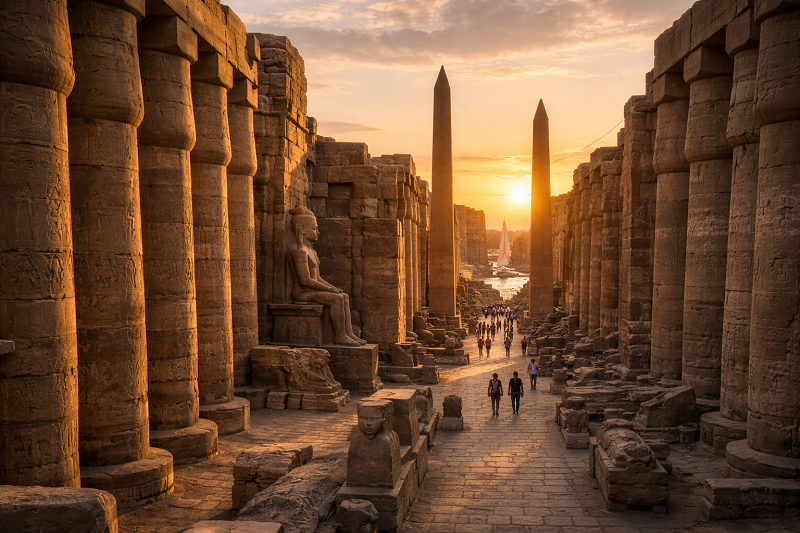
The East Bank: Karnak Temple is a forest of stone. Walk through the Great Hypostyle Hall at "Blue Hour"—just as the sun sets—to see the 134 massive columns glow with a ghostly, golden weight.
The North Coast: The Mediterranean Riviera
Beyond the desert, Egypt’s "Sahel" (North Coast) has evolved into a cosmopolitan rival to the French Riviera. New Alamein City, with its sleek towers and turquoise Mediterranean waters, represents the avant-garde of Egyptian leisure—a place of high-design beach clubs and international film festivals.
The Magelline Perspective
The sights of Egypt are defined by their refusal to fade. Whether it is the wind-sculpted chalk of the White Desert or the mathematical precision of Abu Simbel, these places demand a slower pace. The journey is not about the speed of arrival, but the weight of the silence one finds once there.