 Armenian
 German
 Spanish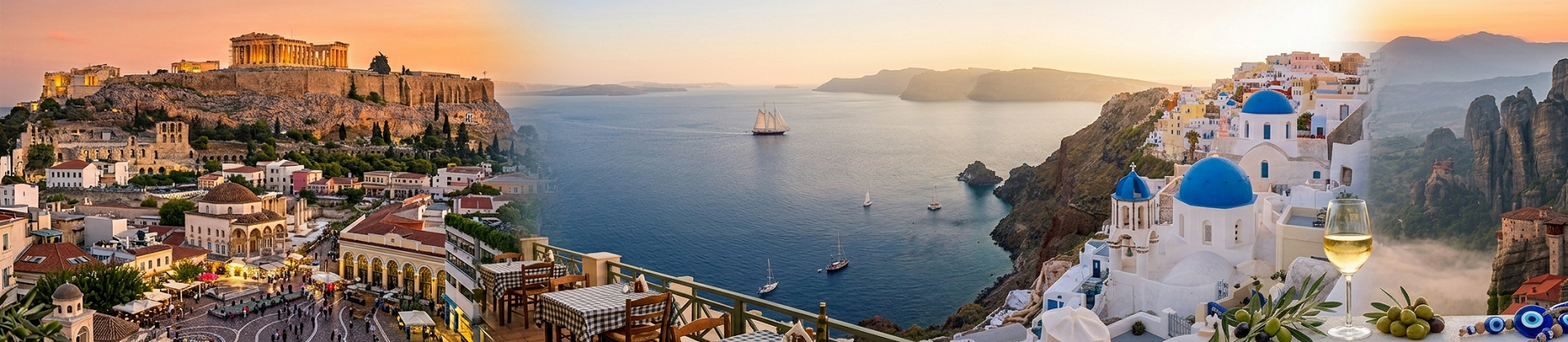
A faithful cartography of wonders, compiled from the chronicles of those who sailed the wine-dark sea and walked the marble-white shores of Hellas. From the crowned height of the Acropolis to the monasteries that defy gravity and gravity alike.
Greece occupies the southernmost tip of the Balkan Peninsula and commands more than six thousand islands scattered across the Aegean, Ionian, and Mediterranean seas, a maritime empire as much as a land nation. Her mountains reach into cloud and her gorges plunge toward volcanic fire, while the sea is never more than a hundred kilometres from any inland point.
This is the land that gave civilization its vocabulary: democracy, philosophy, theatre, the Olympics. Her ruins are not ruins but conversations; each column and carved frieze is a direct address from minds that shaped the Western world. Yet modern Greece is no museum. Her tavernas ring with laughter, her markets burst with colour, and her islands continue to receive pilgrims from every meridian on Earth.
Today, Greece combines ancient heritage with a deeply social modern culture shaped by maritime traditions, café life, Orthodox customs, and an enduring relationship with the sea.
Top Cities to Chart
Athens
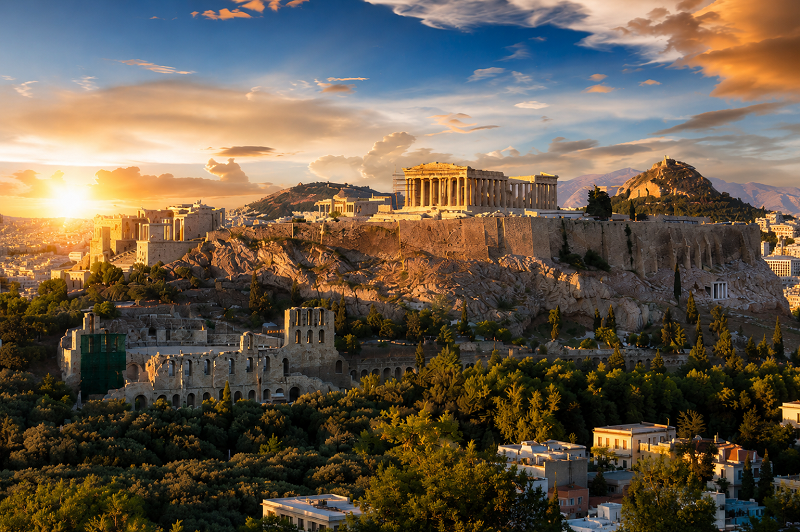
The eternal city where the Acropolis crowns a skyline of neoclassical grandeur and vivid street life. Below the Parthenon, Monastiraki's markets trade in antiquities and spiced meats alike. The cradle of democracy remains restless with ideas.
Santorini
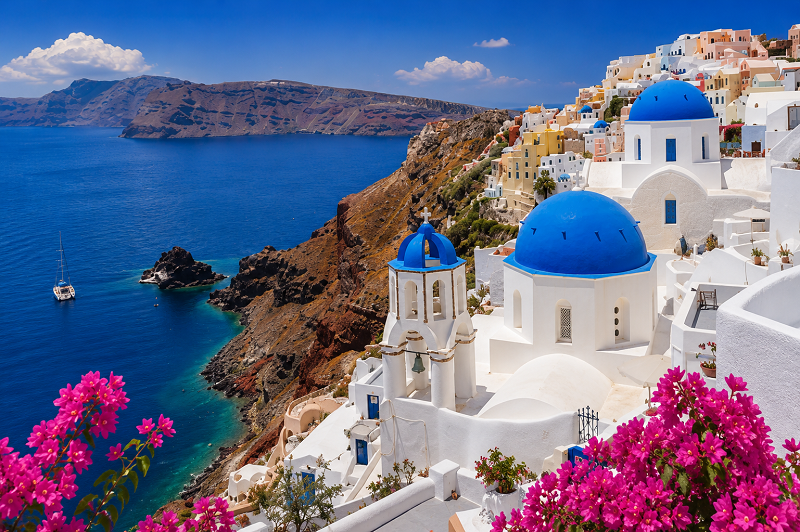
Born of volcanic cataclysm, this crescent island offers blue-domed churches and sugar-cube villages perched above a caldera of impossible beauty. At sunset in Oia, travellers weep without entirely knowing why. Pair the view with local Assyrtiko wine.
Thessaloniki
Greece's northern capital, shaped by Greeks, Ottomans, and Sephardic Jews across many centuries, possesses the finest food market in the country and Byzantine churches so old they predate the Ottoman conquest by a millennium.
Rhodes Town
One of the world's finest surviving walled medieval cities. The Street of the Knights leads between crusader palaces to a harbour where the Colossus once bestrode the entrance. Its walls have repelled every conqueror for seven centuries.
Heraklion
Gateway to the Minoan world and keeper of the labyrinthine palace of Knossos, Europe's oldest city. The Archaeological Museum inside its Venetian walls holds treasures that predate the Trojan War by five centuries.
Nafplio
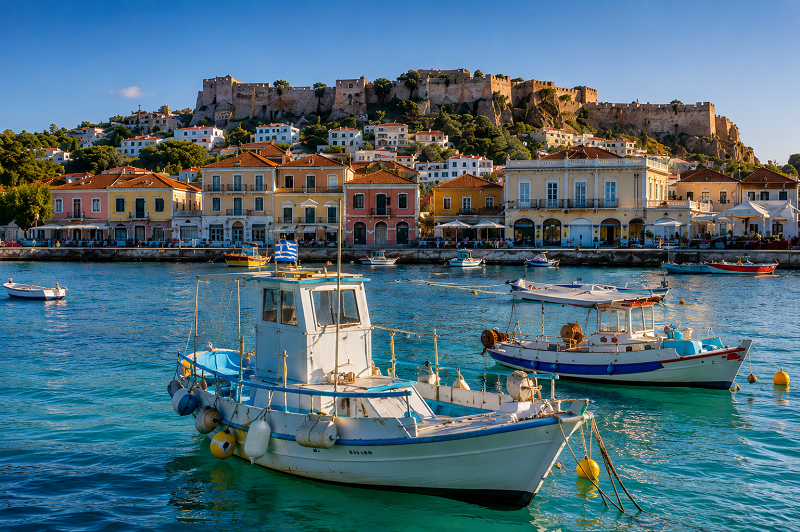
Greece's first modern capital enchants with pastel mansions, a Venetian fort rising from the sea, and lanes fragrant with jasmine. Romantic and unhurried, it is the country's most handsome small city, a cartographer's reward for venturing off the known route.
Must-Try Local Food
Moussaka
Of Ottoman and Levantine ancestry, perfected in Hellenic kitchens: layered aubergine, spiced minced lamb, and béchamel baked to golden bronze, the national dish in all but name. Deeply aromatic, comforting, and wholly satisfying.
Souvlaki
The street food of every port and city square: skewered pork chargrilled over coals, folded into warm pita with tzatziki and raw onion. The definitive Greek fast food, best eaten standing at a pavement counter.
Spanakopita
Found in every bakery from first light: crisp phyllo pastry filled with spinach, crumbled feta, and fresh herbs. The ideal companion to a strong Greek coffee at the beginning of any day's expedition.
Loukoumades
Cited by Homer as offerings to the Olympic victors: ancient honey-drenched dough fritters, served hot with cinnamon and sesame. Three thousand years of culinary tradition survive in each golden ball.
Saganaki
Theatre at the table: kefalograviera cheese pan-fried in olive oil to a golden crust, often flambéed tableside with the theatrical cry of "Opa!" The smoke and applause are included.
Galaktoboureko
Among the finest achievements of Hellenic pastry: silky semolina custard encased in shattering phyllo and soaked in citrus-scented syrup. Best taken cold on a long summer afternoon beside the sea.
Unique Cultural Traditions
Name Days Above Birthdays
Greeks celebrate the feast day of their patron saint with greater ceremony than a birthday. Friends arrive unannounced bearing sweets; the host receives all with open doors and a laden table, a custom of generosity so ingrained it requires no invitation.
The Evil Eye: Mati
Belief in the mati, the malicious glance of envy that carries misfortune, is woven into Greek life at every level. Blue glass eye amulets hang in homes, vehicles, and around the necks of newborns. To receive one as a gift is to receive protection itself.
Orthodox Easter: The Holiest Night
Greek Orthodox Easter eclipses Christmas in national significance. At midnight on Holy Saturday, candlelit processions fill every churchyard in the land. The fast breaks with magiritsa soup; lamb roasts over coals through Easter Sunday in a communal celebration of resurrection and rebirth that no other European festival matches for fervour.
Kefi: The Spirit of High Joy
Kefi, untranslatable in any chart or lexicon, is the spirit of communal joy that transforms any gathering into a celebration. When kefi seizes a taverna, the music grows fierce, plates may shatter on the floor, and strangers become lifelong companions by the second glass of ouzo.
Monuments & Sacred Sites
The Acropolis of Athens
The supreme monument of Western civilization. The Parthenon, Erechtheion, and Propylaea crown a limestone hill above the city with a grandeur no subsequent age has equalled. Arrive before dawn so the marble catches its first light alone; the effect is of witnessing creation itself.
Palace of Knossos (Heraklion, Crete)
Europe's oldest city, the labyrinth of the Minotaur, reveals a Bronze Age civilisation of astonishing sophistication. Its frescoed halls and plumbing systems predate classical Greece by a thousand years. The myth is inseparable from the ruin.
Ancient Delphi (Mount Parnassus, Central Greece)
Once the navel of the world, where the Oracle issued prophecies that bent the course of empires. The sanctuary of Apollo, Sacred Way, and ancient theatre are set into cliffs of such drama that even the ruin communicates the awe it was designed to produce.
Meteora Monasteries (Thessaly, Central Greece)
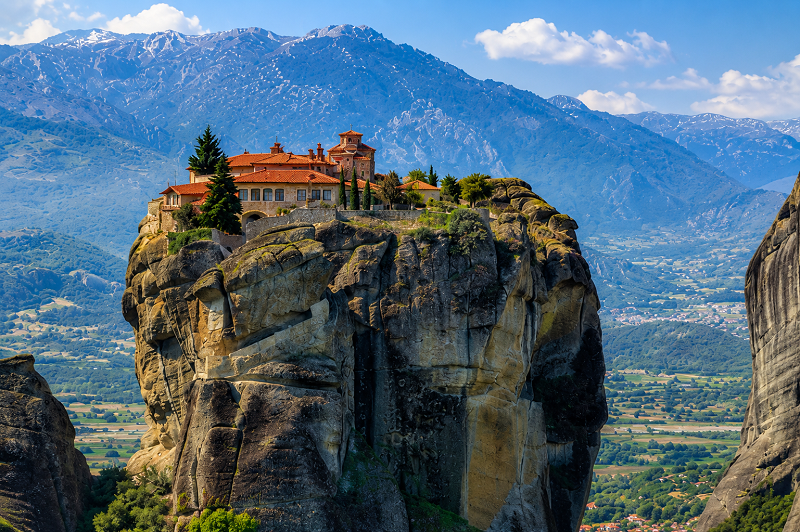
Six Eastern Orthodox monasteries balanced upon near-vertical rock pillars rising 400 metres from the Thessalian plain. A UNESCO World Heritage Site of supernatural drama, best seen emerging from winter mist, when the pinnacles appear to float entirely free of the earth.
Oia, Santorini (Cyclades, South Aegean)
Blue-domed churches and white-washed staircases cascade toward a volcanic caldera in one of the world's most photographed compositions. Beyond the famous sunset, the underground wine caves carved into volcanic tufa offer a quieter encounter with the island's true nature.
Ancient Olympia (Elis, Peloponnese)
The birthplace of the Games, held from 776 BC onward, with a sacred truce that halted all wars across the Greek world every four years. The Olympic flame is still ceremonially kindled here before each modern Games: an unbroken thread of fire running from antiquity to the present day.
The American author Henry Miller once wrote in The Colossus of Maroussi that Greece is a good place to look at the moon, isn't it? You feel the heroes are sleeping all around you.
The Magelline Perspective
We have sailed many seas and catalogued many shores: the spice coasts of the East, the silent vastness of the Pacific, the treacherous cape at the end of the world. Yet no passage prepares a navigator for his first sight of Hellas rising from the Aegean.
These are waters that carry memory in their currents. Every cape and promontory bears a name that reaches back beyond the age of charts. The mountains appear as the ancients painted them: bone-white against impossible blue sky, carved by gods who did not yet know they would be forgotten. To sail into Piraeus is to understand, at last, why every civilisation that came after has looked backwards here with longing.
What the navigator finds in Greece that he finds nowhere else is this: a land where the layers of time are not hidden but displayed.The ancient temple stands beside the Byzantine church; the Byzantine church beside the Ottoman fountain; the Ottoman fountain beside the modern café, and none of them contradict each other. Each layer is honest about what it is. In this, Greece teaches the greatest lesson a voyage can offer: that to know where you are, you must first understand every journey that has brought the world to this precise coordinate.
Mark these shores upon your chart with care. They will not disappoint the faithful traveller, for here, more than anywhere else we have yet anchored, the journey and the destination are one and the same.