
 Armenian
 German
 Spanish

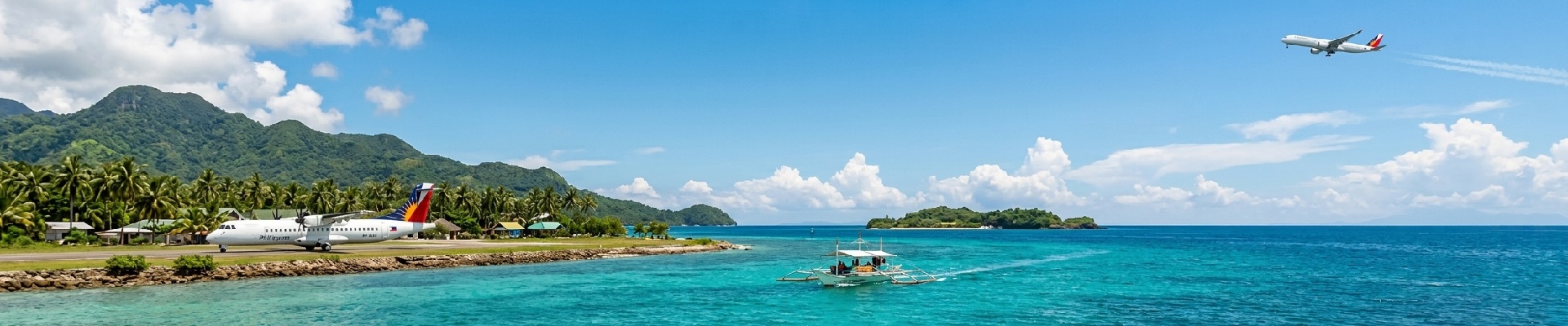
Airports in the Philippines
A trip to the Philippines usually begins on a widebody into Manila or Cebu. From there a narrowbody carries you on to a provincial town. Then a propeller aircraft drops onto a strip between palms and limestone, and the last stretch often happens on a banca, the outrigger boat that does the work roads do elsewhere.
That step down in scale explains the country's airports better than a map does. The Philippines is spread across thousands of islands, and its airports work in layers. A few receive long flights from the Gulf, East Asia and North America. A wider ring handles domestic jets. At the edge sit the island fields, short and busy, where the aircraft is often the smallest one you will board all year.
Manila is the largest gateway, though it is not the region's connecting hub. Singapore, Hong Kong and Bangkok handle far more transfer traffic. Most visitors treat Manila or Cebu as a door and keep moving.
The Main Gateways
Manila's Ninoy Aquino International (MNL) sits inside the city, and the approach passes low over rooftops and traffic. Four terminals are spread around the runways, and they are not connected airside. Changing terminals means leaving security, riding through airport roads and city traffic, and clearing security again. A free shuttle bus links the buildings, but a connection between terminals needs a generous gap. A private operator now runs the airport and is reworking it in stages, with new lounges, food halls and automated immigration gates. Airlines have changed terminals more than once, so check the terminal on your booking. There is no rail link yet, so Grab, taxis and airport buses carry passengers into the city.
Philippine Airlines flies from Manila to Los Angeles, San Francisco and Tokyo. Emirates, Qatar Airways and Etihad connect Manila with Europe through Dubai, Doha and Abu Dhabi. Cebu Pacific runs a dense budget network from here across Asia.
For travelers skipping Manila entirely, Mactan Cebu International (CEB) is often the easier entry point. Its international terminal rests under curved arches of laminated timber, and it feels closer to a resort than a transit building. Cebu lies in the middle of the Visayas, so it suits trips to Bohol, Siargao and the southern islands.
North of Manila, in Pampanga, a former air base has become Clark International (CRK). On clear days Mount Arayat rises from the plain beyond the runway. Its newer terminal handles a growing list of flights within Asia. Clark has also taken over the propeller flights that once left from Manila, so it now serves as the starting point for many island trips, including Coron, El Nido and Siargao.
In the far south, Mindanao has its own door at Davao International (DVO), with Mount Apo, the country's highest peak, on the skyline.
The Island Airports
Boracay feels close because of Caticlan (MPH), officially Godofredo P. Ramos Airport. Its extended runway takes A320 jets from Manila and Cebu, and the jetty is a short ride from the terminal. The airport now handles evening flights too, but it sits close to the sea, so bad weather can still cancel them. Kalibo (KLO), on the same island of Panay, handles most of the international traffic for Boracay, including flights and charters from East Asia. The road from Kalibo to the jetty is long, so most domestic travelers choose Caticlan.
If you are heading to Palawan, three airports handle most arrivals. Puerto Princesa (PPS) takes jets and suits the underground river and the long road north. El Nido (ENI) is a small private airfield where the terminal feels more like a beach pavilion. Only small propeller aircraft land there, and seats sell out early. Busuanga (USU) serves Coron, with the limestone lagoons a drive and a boat ride away.
Bohol Panglao (TAG) is a newer airport close to the Panglao beaches, with domestic flights and some services from East Asia. Siargao (IAO) is a small field at Sayak, on the country's best known surfing island. Flights arrive from Cebu and Clark.
Before You Fly
Domestic flights fill fast around holidays. The smallest aircraft carry tight baggage limits, often lower than your international ticket allows. Typhoons can move island schedules, so leave a spare day before an international departure.
Every traveler entering or leaving the country registers on the government eTravel portal at etravel.gov.ph, within 72 hours before arrival or departure. Registration is free, and sites that charge for it are not official. Many nationalities enter without a visa for a limited stay. Terminals, schedules and entry rules change here more often than in most countries, so confirm the details with your airline and official sources before you travel.
Magelline Perspective
If you are flying in from Europe or the Gulf for Boracay or Bohol, Cebu is often a better entry point than Manila. For El Nido, Coron and Siargao, check whether your island flight leaves from Clark before you book a Manila arrival, since the transfer between them is a road trip. Manila makes sense for Luzon and the north, and Davao for Mindanao.
The terminals are usable, and the newer ones are good. Service still varies by building and by hour. What stays with most travelers is the last leg: a small aircraft, a short runway, a boat waiting at the shore. In the Philippines the plane shrinks as the trip gets better.