
 Armenian
 German
 Spanish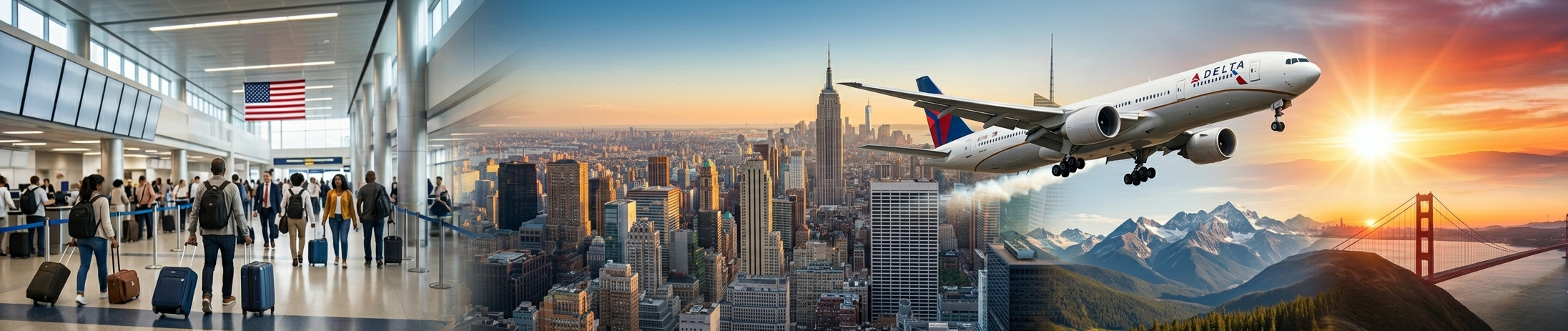
Stretching from the Atlantic to the Pacific and from the sun-baked shores of Florida to the frozen peaks of Alaska, the United States of America stands as one of the world's most expansive and complex aviation nations. Whether you are arriving for iconic city skylines, vast national parks, vibrant cultural scenes, or the pulse of global commerce, America's airports serve not merely as entry points, but as the opening act of a journey measured not in miles, but in experiences.
From colossal intercontinental mega-hubs to well-connected regional gateways, the US air transport network reflects the country's character: bold, ambitious, and built for motion. Here, the sheer scale of the aviation system mirrors the scale of the country itself, a continent-sized land where flying is not simply convenient, it is essential.
America's airports are recognised for their diversity, ambition, and constant reinvention. Major hubs such as New York, Los Angeles, Chicago, and Atlanta serve as critical nodes connecting the United States with every corner of the globe, while an extensive domestic network links hundreds of cities, towns, and regions with remarkable frequency. Dozens of daily flights between major cities ensure that distances which would take days to drive can be bridged in a matter of hours.
One of the United States' greatest aviation strengths lies in the depth of its domestic network. Whether you are continuing to New England, the Deep South, the Pacific Northwest, or the American Southwest, onward connections are plentiful, well-timed, and served by a broad range of carriers from full-service airlines to efficient low-cost operators. Ground transportation from major airports, including rail links, metro systems, buses, and rideshare services, continues to develop rapidly, making city-centre access increasingly seamless.
Thanks to its geographic position bridging the Atlantic and Pacific worlds, the United States serves as a natural transit hub between Europe, Latin America, and Asia. It offers unparalleled access not only within its own vast borders, but also to Canada, Mexico, the Caribbean, and destinations far beyond. Whether your journey is driven by adventure, history, creativity, business, or simply the desire to explore one of the world's most varied destinations, the USA's airports offer a confident and well-equipped welcome.
Below are the ten principal airports of the United States, each serving as a gateway to distinct regions and experiences:
Hartsfield-Jackson Atlanta International Airport (ATL): the world's busiest airport by passenger numbers, serving as the primary hub of Delta Air Lines and a key transfer point connecting North America with Latin America, Europe, and beyond.
Los Angeles International Airport (LAX): the main gateway to the west coast and the entertainment capital of the world, offering extensive transpacific and transatlantic routes alongside a vast domestic network.
O'Hare International Airport (ORD): Chicago's flagship airport and one of the busiest hubs in North America, connecting the American Midwest with global destinations across six continents.
Dallas/Fort Worth International Airport (DFW): a vast hub at the geographic heart of the country, serving as the primary base of American Airlines with strong connections throughout the Americas and beyond.
Denver International Airport (DEN): the gateway to the American Mountain West and Colorado's outdoor landscapes, offering a broad range of domestic and growing international connections.
John F. Kennedy International Airport (JFK): New York's primary international gateway, handling the city's transatlantic, transpacific, and Latin American traffic with a global range of carriers and destinations.
San Francisco International Airport (SFO): the main hub for the Bay Area and Silicon Valley, offering strong transpacific routes to Asia alongside comprehensive domestic and European connectivity.
Seattle-Tacoma International Airport (SEA): the gateway to the Pacific Northwest and a key hub for Alaska Airlines, providing strong connections to Asia, Canada, and destinations across the continental US.
Miami International Airport (MIA): the principal gateway to Florida and the leading US hub for Latin America and the Caribbean, serving as a critical connection point between the Americas.
Newark Liberty International Airport (EWR): a major international gateway for the New York metropolitan area, offering extensive transatlantic routes and serving as a primary hub for United Airlines.
For international arrivals into the United States, travellers should be prepared for immigration and customs procedures, which can be time-consuming at major hubs during peak periods. It is advisable to allow several hours for connections at busy airports such as Atlanta, JFK, and LAX. Most major airports offer clear signage, multilingual assistance, and a wide range of facilities to make the transit experience as comfortable as possible.
In Magelline's view, the airports of the United States are not simply logistical spaces, they are the threshold to a country of extraordinary contrasts and boundless possibility. From the moment wheels touch the runway, the scale, the energy, and the sheer variety of America begin to reveal themselves. Step through arrivals, and step into a journey unlike any other.
