
 Armenian
 German
 Spanish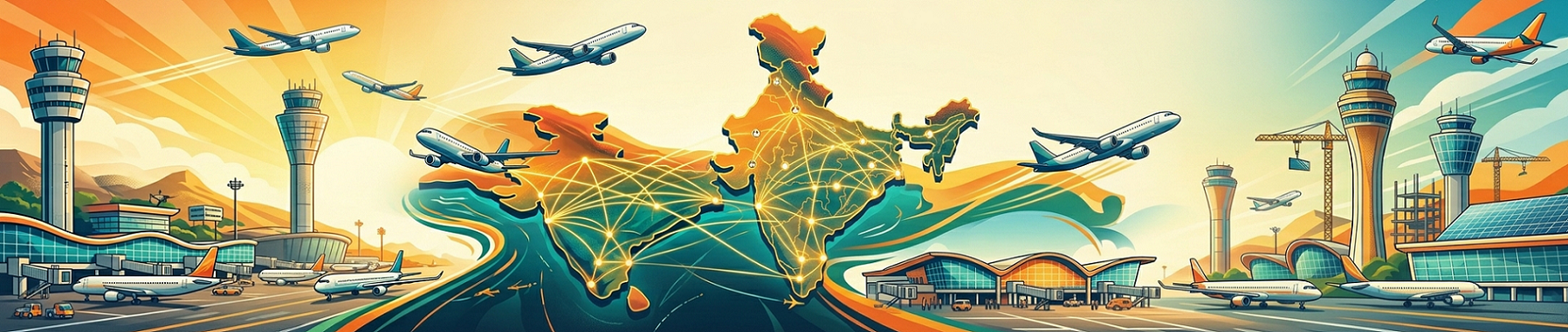
India's aviation network is expanding at a pace rarely seen anywhere in the world. With more than 160 airports now in operation, up from around 70 a decade ago, the country is investing heavily in new terminals, runways and entire greenfield airports to keep up with rapidly growing passenger numbers.
Today's Major Hubs
Indira Gandhi International Airport (DEL) in Delhi remains India's busiest airport and its main gateway for international arrivals. Its three runways and multiple terminals handle a large share of the country's long-haul connections to Europe, the Middle East, Asia and North America.
Chhatrapati Shivaji Maharaj International Airport (BOM) in Mumbai is the second busiest hub, serving as the primary entry point for India's financial capital. Built on a relatively compact site within the city, it has long operated close to capacity, which is part of the reason a second airport for the region became a priority.
Kempegowda International Airport (BLR) in Bengaluru and Rajiv Gandhi International Airport (HYD) in Hyderabad both serve as major hubs for South India, supporting the region's technology and business sectors with strong domestic and growing international links. Hyderabad's airport also covers one of the largest land areas of any airport currently operating in the country.
Other significant airports include Chennai, Kolkata, and Cochin International Airport (COK) in Kerala, recognised as the world's first fully solar-powered airport.
New Airports Reshaping the Map
Two major projects have recently transformed India's aviation landscape. Navi Mumbai International Airport (NMIA) was developed to relieve pressure on Mumbai's main airport. Meanwhile, Noida International Airport (DXN) at Jewar, near Delhi, was inaugurated in March 2026 and is set to become one of the largest airports in Asia once fully developed, with a planned land area far exceeding any existing Indian airport. Its first phase has a capacity for around 12 million passengers a year, with flights to multiple cities launching throughout 2026. The airport is connected to Delhi via the Yamuna Expressway, and a rapid rail link is planned for the coming years to improve connectivity further.
Future Plans
India's civil aviation authorities continue to expand the network under regional connectivity schemes, bringing smaller cities into the air travel map for the first time. Expansion works are ongoing at several major hubs, including new terminals and additional runways aimed at increasing capacity well beyond current levels.
Noida International Airport is expected to grow in phases toward its full planned size over the coming years, eventually positioning it among the largest airports in the world by area, while Navi Mumbai is targeting international services and a significant rise in daily passenger numbers within its first year of operation.
The Largest Airports in India
By planned land area, Noida International Airport (Jewar) is set to become the largest in the country once complete. Among currently operating airports, Hyderabad and Delhi rank among the largest by land area, followed by Navi Mumbai, Goa's Mopa Airport, Mumbai, Kolkata, Cochin, Chennai and Ahmedabad.
By passenger numbers, Delhi remains the busiest airport in the country by a wide margin, with Mumbai, Bengaluru and Hyderabad following behind.
In Magelline's view, India's airports are in the middle of one of the most ambitious transformations in modern aviation. Travelers planning trips to Delhi or Mumbai in particular should double-check which airport their flight actually serves, as the new gateways at Jewar and Navi Mumbai sit some distance from the older airports and city centres. For now, the established hubs remain the most reliable choice, while the new airports promise smoother journeys as their connections mature.
