
 Armenian
 German
 Spanish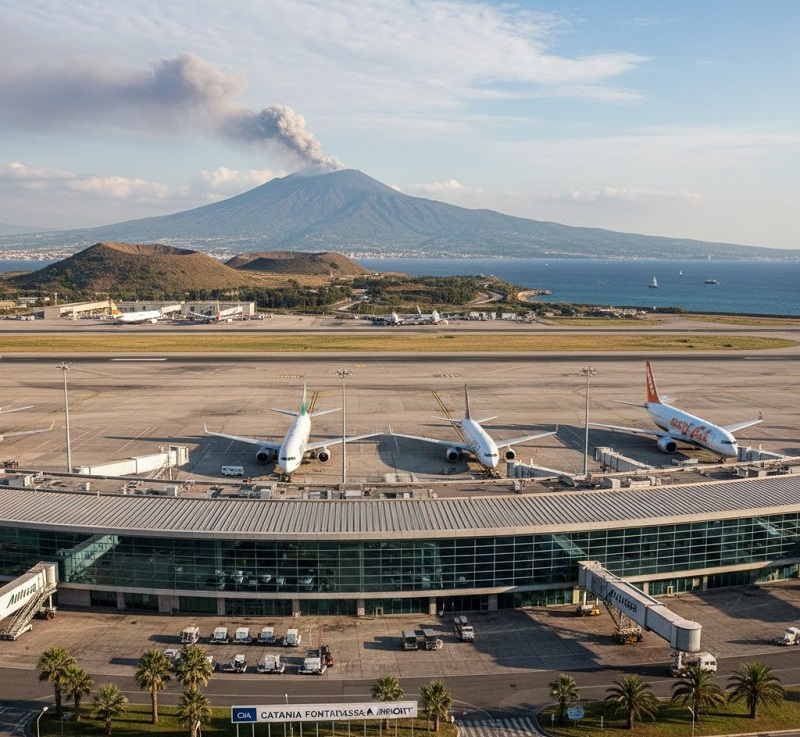

 Catania–Fontanarossa Airport
Catania–Fontanarossa Airport (CTA), also known as Vincenzo Bellini Airport, lies just 2.6 miles southwest of Catania, Sicily’s vibrant second city. Named after the beloved opera composer Vincenzo Bellini, the airport carries the soul of a land where drama, nature, and history have always been inseparable.
According to Assaeroporti, CTA is the busiest airport in Sicily. Major European carriers such as ITA Airways, Lufthansa, and KLM connect Catania with Rome, Munich, Amsterdam, Berlin and beyond, while low-cost airlines like easyJet and Ryanair link Sicily with London, Paris, and other sought-after destinations.
But in Catania, even aviation bows to nature.
At times, Mount Etna — ancient, unpredictable, magnificent — scatters volcanic ash into the sky, briefly pausing the rhythm of flight. The airport and the volcano coexist like two characters in the same Sicilian opera.
CTA is not only a gateway but a growing multimodal hub. The new rail station, Catania-Aeroporto Fontanarossa, integrates the airport into the suburban railway grid. A quick 10-minute journey brings passengers to Catania Centrale, while trains to Syracuse or Taormina glide along the coast in under an hour.
By road, the airport sits beside the A19 motorway, the main artery to Palermo and central Sicily, while the E45 leads south toward Syracuse. Shuttle buses link the terminal with Catania’s city centre and the Central Train Station, and long-distance buses to towns across the island depart directly from the airport. The main bus station lies just a 10-minute walk from the heart of the city.
As the leading airport of Southern Italy, Catania–Fontanarossa is expanding its horizons.
The construction of Terminal B — positioned between Terminals A and C — represents the new architectural soul of CTA. Developed across five levels, it unifies the entire passenger complex and lays the foundation for future growth. Planned upgrades to Terminal A, including the expansion of the Departures and Extra-Schengen areas, will gradually shape CTA into Sicily’s next great transportation nexus.
Through modern systems and energy-efficient design, the project aims to reduce CO₂ emissions by 10–20% and energy consumption by 15–30%, supporting a bold commitment to reach Carbon Zero by 2030.
In Magelline’s eyes, Catania–Fontanarossa is the moment Sicily inhales — a gateway where land, fire, and sea converge into a single breath of life.
Here, under Etna’s quiet vigilance, the runways shimmer with heat and memory. Flights glide over a luminous gulf, revealing a city draped in pastel tones, woven from myth, courage, and centuries of southern spirit.
CTA is Sicily’s awakening, the warm pulse that greets every traveller. A place where arrival feels like stepping into an ancient tale already in motion.