 Armenian
 German
 Spanish
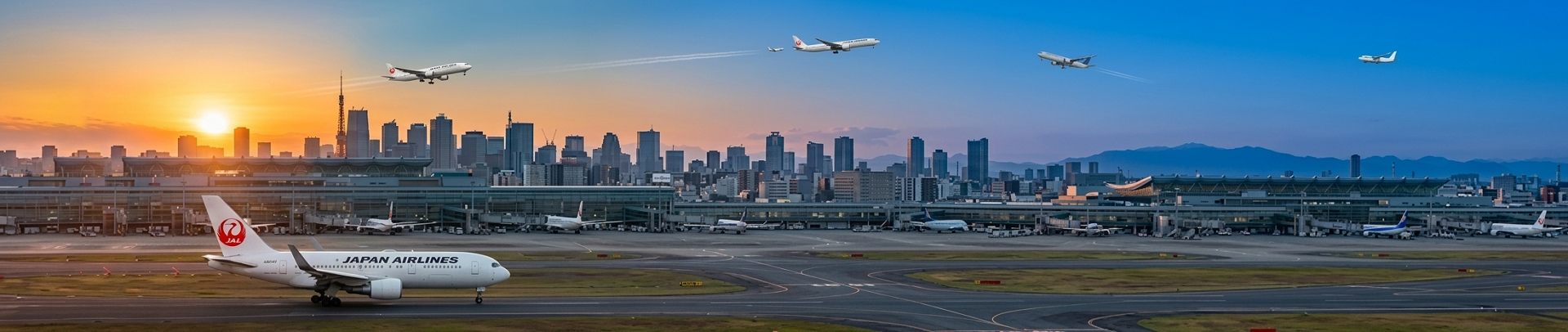
Japan receives its visitors with a precision that feels less like efficiency and more like art. Whether you are descending through morning cloud into the vast sprawl of Tokyo, stepping off a domestic flight into the snow-laden calm of Hokkaido or arriving by night to the luminous harbour-adjacent terminals of Osaka, Japan's airports are the opening act of one of the world's most immersive travel experiences. They are where the journey truly begins.
From the twin international titans of Haneda and Narita to the quietly distinctive regional gateways of Kyushu and Okinawa, Japan's air transport network mirrors the country's essential character: disciplined yet warm, relentlessly forward-looking yet anchored in a sense of place that few nations can rival. Here, even the descent through clear Pacific air carries a particular quality of anticipation.
Japan's aviation infrastructure is among the most sophisticated on earth. With over fifty active airports, including several major international hubs, the country is exceptionally well connected, a network built not only to serve the great metropolitan centres but to bind together an archipelago of islands, mountain regions, and peninsulas that geography alone could easily render remote.
By 2024, Japan’s airports had fully reawakened, welcoming over 300 million passengers, including more than 100 million international travellers, a clear return to pre-pandemic rhythms. In the next year, however, recovery had already evolved into expansion, with domestic travel reaching record highs and international demand continuing to climb across both global hubs and regional gateways.
One of Japan's defining characteristics as an aviation nation is the remarkable balance it strikes between concentration and dispersal. Two airports share the burden of Tokyo's global connectivity, while a constellation of regional gateways serves the country's distinct and deeply individual corners. Narita leads Japan's international traffic with a 33% share, followed by Kansai with 24% and Haneda with 22%. Yet beyond these figures lies something more telling: each airport in Japan opens onto a world of its own, separated by climate, cuisine, dialect, and landscape from the one before it.
English is spoken widely throughout the major terminals, signage is exemplary, and the standards of cleanliness, punctuality, and service that define Japanese public life extend seamlessly into the airport experience. Ground connections by rail, in particular, are frequently among the best in the world. Pre-booking transfers is advisable during the Golden Week holidays in late April and early May, the Obon period in August, and the New Year travel season, when Japan's airports operate at their most intense.
Below are the principal Japanese airports, each a gateway to a distinct and endlessly rewarding region:
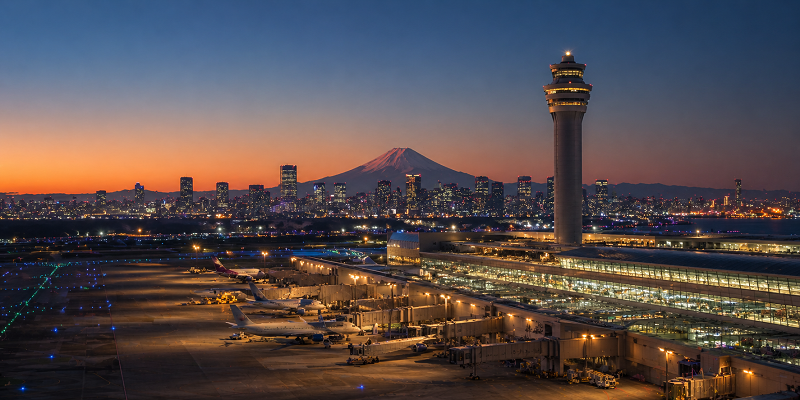
Tokyo International Airport "Haneda" (HND): Japan's largest airport by total passengers and, for many travellers, the preferred gateway to the capital. Located just fourteen kilometres south of Tokyo's city centre, Haneda handles well over 85 million passengers annually. The airport operates across three terminals. An underground walkway connects terminals 1 and 2, while a free inter-terminal shuttle bus links all three on the landside; together, the three terminals offer 71 gates served by jet bridges.
Terminal 3, the international gateway, is the heart of the long-haul experience: it carries 20 jet-bridge gates and airline lounges operated by Japan Airlines, Cathay Pacific, ANA, and Delta Air Lines, representing all three major global alliances.
The duty-free offer is formidable, and the airside shopping in Terminal 3 feels like a luxury boutique mall, featuring international houses alongside premium Japanese brands in cosmetics and whisky. The landside Edo Koji corridor recreates a historic Tokyo streetscape with traditional craftwork and food, ensuring even the hours before departure feel like the beginning of something.
Check-in across all terminals is supported by self-service kiosks and bag-drop automation, and in 2022, Haneda achieved the world's highest on-time international departure rate at 90.3%, a figure that says everything about the precision with which this airport operates.
Narita International Airport (NRT): The great long-haul gateway of Japan, sitting some sixty kilometres east of central Tokyo, and the airport through which most intercontinental visitors first set foot on Japanese soil.
Narita served 39.8 million passengers in 2024, confirming its role as Japan's leading international hub. The airport is divided across three terminals:
- Terminal 1 is the largest, with 40 gates and the most comprehensive amenities, split across a North Wing, Central Building, and South Wing.
- Terminal 2 follows with 32 gates, including a satellite building accessible after passport control.
- Terminal 3 serves low-cost carriers with 23 gates in a deliberately pared-back configuration.
Terminal 1 is home to Nakamise, the largest airport duty-free shop and brand mall in Japan, where the offer spans everything from Shinkansen-wrapped confectionery to Shiseido's finest. Each terminal features airline and independent lounges, including the JAL Sakura Lounge, ANA Lounge, and Delta Sky Club in Terminal 2, with Plaza Premium access available across multiple concourses.
The check-in and boarding experience at Narita has been fundamentally reimagined: the airport has rolled out Japan's first end-to-end biometric departure process, allowing passengers to move from check-in through security screening and boarding by facial recognition alone, without presenting physical documents at any stage.
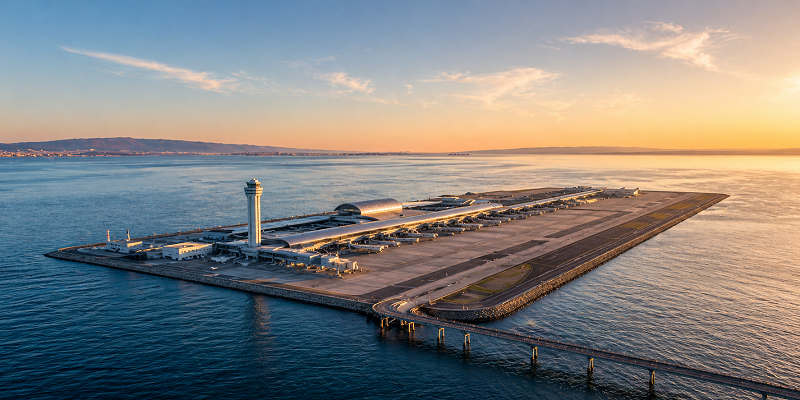
Kansai International Airport (KIX): One of the architectural wonders of the aviation world, built entirely on a man-made island in Osaka Bay and designed by Renzo Piano. Its offshore construction was itself prompted by community resistance to jet noise, making it one of the few airports born as much of civic negotiation as engineering ambition.
The gateway to Osaka, Kyoto, Nara, and Kobe, Kansai has just completed a transformative modernisation of Terminal 1 ahead of the Osaka Expo. The renovation introduced new check-in areas with a self-bag-drop system shared between airlines, ten latest-generation AI-powered security screening lanes, e-gate immigration control among the fastest in the world, and call-to-gate technology, achieving a remarkable result: 95% of passengers clear security in under five minutes.
The retail and lounge transformation is equally ambitious: the airport now hosts the largest walkthrough duty-free shop in Japan, and one of the biggest business and premium lounges in the world, with capacity for more than 1,000 passengers, including families. The overall capacity of Terminal 1 has been raised to 40 million passengers annually, positioning Kansai not merely as Japan's western gateway but as one of Asia's most forward-looking aviation destinations.
Fukuoka Airport (FUK): The principal gateway to Kyushu and an airport celebrated as much for its extraordinary urban convenience as for its connectivity. Fukuoka Airport sits just three kilometres from Hakata Station in the heart of the city, connected by subway in minutes.
The airport's international terminal completed a full grand opening in March 2025, and the transformation is dramatic.
Seven new smart security lanes, the priority lane in Kyushu, have roughly doubled screening capacity, while CT scanning technology means passengers no longer need to remove laptops from bags. The duty-free zone has been quadrupled in size to approximately 6,000 square metres, arranged in a walkthrough style so that passengers naturally move through the retail offer after immigration, with 44 new brands including cosmetics, fashion, and the airport's first boutique dedicated exclusively to Japanese labels.
The new Lounge Fukuoka on the fourth floor, almost double its previous size, now commands a sweeping view of the tarmac and is decorated throughout with Hakata dolls, Hakata-ori textiles, and traditional handicrafts, a lounge that feels, entirely appropriately, like Kyushu in miniature.
Self-service check-in kiosks have increased to 38, and 14 new self-bag-drop counters have been introduced, reflecting the airport's commitment to what it calls a "Free, Fast, Fun" passenger philosophy.
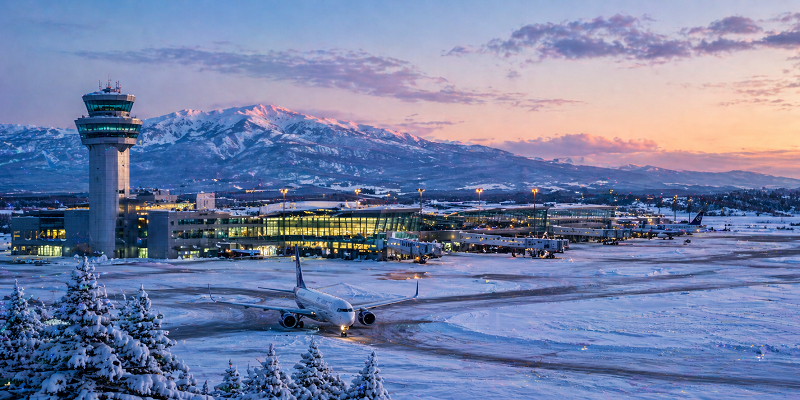
New Chitose Airport (CTS): The gateway to Hokkaido, Japan's great northern island, and the airport through which travellers enter a landscape of volcanic calderas, lavender fields, world-class ski resorts, and seafood of almost implausible quality. New Chitose opened in 1988 to serve the Sapporo metropolitan area and became Japan's first 24-hour airport in 1994. It operates across two distinct terminals, a large, semicircular domestic terminal with 18 jet-bridge gates, and a dedicated international terminal opened in 2010 with 8 gates. Lounge options include the ANA Lounge and JAL Diamond Premier Lounge airside in the domestic terminal, the Royal Lounge in the international terminal, and the Super Lounge accessible across both. The airport is presently introducing smart security lanes to its domestic screening, reflecting a national push to modernise passenger processing, and digital check-in enhancements are being integrated across both terminals.
What makes New Chitose genuinely singular, however, is what lies beyond the gates: the domestic terminal contains a hot spa, a cinema complex, Japan's first airport movie theatre and a hotel, while the international terminal houses a luxury property with runway views and an onsen.
Skytrax recognised the airport's progress by naming it the World's Most Improved Airport for 2024, vaulting it from 102nd to 49th in the global rankings. The rail connection to Sapporo is reachable in 37 minutes, making the onward journey as seamless as the landscape is spectacular.
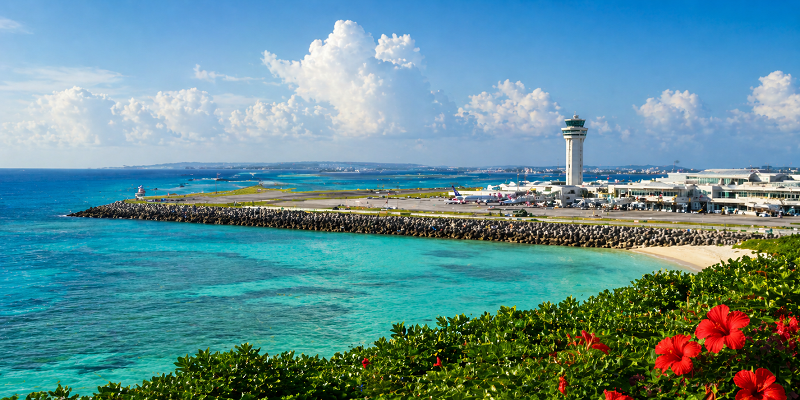
Naha Airport (OKA): The gateway to Okinawa, Japan's subtropical southern archipelago and a destination unlike any other in the country, closer in climate and spirit to Southeast Asia than to the temperate north. It's Japan's sixth busiest airport and the primary terminal for Okinawa Prefecture, serving scheduled international routes to Taiwan, Hong Kong, South Korea, Thailand, Malaysia, Singapore, and mainland China.
The terminal operates on a single integrated building spanning multiple floors, with check-in counters, arrival facilities, and a growing airside retail and dining offer. The duty-free selection reflects Okinawa's unique position at the crossroads of Japanese and Ryukyuan culture, with locally distilled awamori spirits, tropical confectionery, and island ceramics sitting alongside the standard international brands.
Naha serves as the hub for Japan Transocean Air, which connects the main island to surrounding prefectures, and Ryukyu Air Commuter, which links the Okinawa main island to the outer islands of the archipelago.
Ground transport connections are efficient, and the airport's 24-hour operation makes it well-suited to the long-haul onward legs that many Okinawa visitors require. It is the arrival point for travellers drawn to the island's extraordinary marine environments, its coral reefs, and its unhurried, sun-drenched pace of life and the airport, warm and purposeful, sets that tone from the moment the aircraft door opens.
In Magelline's view, Japan's airports are not merely the functional prelude to travel; they are the first immersion. The moment the cabin door opens, the country begins: the quiet order of the jet bridge, the impeccable signage, the staff who bow as you pass, the biometric gate that reads your face and waves you through without a word. Step into the arrivals hall, feel the particular hum of a nation organised around welcome, and understand that you have entered somewhere that takes every detail seriously, including the moment of your arrival. The journey, from here, requires only your full attention.