 Armenian
 German
 Spanish
 2026-09-25 00:30:00
Osaka grew rich as a merchant city, and people here still talk to strangers more easily than in most of Japan. An old local greeting, "Mokarimakka?", asks whether business is going well. The city even has its own word for its favourite habit. Kuidaore means eating until you can't eat anymore, and most visitors end up doing exactly that.
Dotonbori
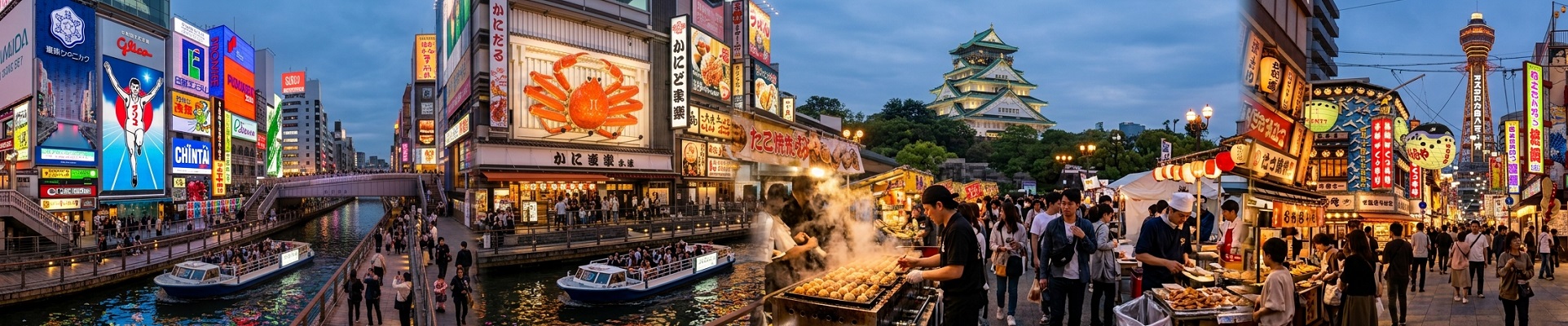
The canal in the Namba district is lined with huge neon signs, and above one restaurant door a giant mechanical crab slowly moves its legs. The Glico running man sign by Ebisu Bridge has stood here in different versions since 1935. People queue to take a photo in front of it at almost any hour.
The street is best in the evening, when the signs are lit, and the food stalls are busy. Try takoyaki, small balls of batter with octopus inside, cooked in iron pans right in front of you. Okonomiyaki, a savoury pancake with cabbage and pork, is made on a hot plate at your table. If you don't know how to eat something, the cook will usually show you. Weekend crowds are heavy, so a weekday evening is more comfortable.
Osaka Castle
Toyotomi Hideyoshi began the castle in 1583, and it was burned and rebuilt several times over the following centuries. The tower standing today, white with green roofs, was built in 1931. Some of the stones in its walls weigh more than a hundred tonnes, and it is hard to imagine how they were moved without machines.
The tower holds a museum about the warlords who fought for control of Japan. Many people enjoy the park around the moat even more, especially in spring when the cherry trees bloom and in autumn when the ginkgo leaves turn yellow. The tower opens at nine, and if you arrive then you can see the top floor quietly before the tour buses come.
Kuromon Ichiba Market
This covered market has supplied the city since the early nineteenth century, and locals still call it Osaka's Kitchen. About 150 shops stand along a street of roughly 600 metres. You can buy grilled scallops, fresh tuna, sea urchin and very large Japanese strawberries, and most stalls let you eat on the spot.
Mornings are the best time to come, because the seafood is freshest and the lanes are less crowded. Many Osaka families have shopped at the same stalls for generations.
Shinsekai & Tsutenkaku Tower
Shinsekai was built in 1912, and its planners took ideas from Paris and from Coney Island in New York. The name means New World. A century later, the district has a nostalgic look, with retro game arcades, painted signs and small bars where you eat at a counter.
Tsutenkaku Tower stands in the centre of the district. Inside is a statue of Billiken, a god of good luck, and visitors rub the soles of his feet for fortune. The local speciality is kushikatsu, meat and vegetables on skewers fried in breadcrumbs. Every table has a shared pot of sauce, and dipping a skewer a second time after you have bitten it is not allowed.
Umeda Sky Building
The Umeda Sky Building has two towers connected at the top by a round observation deck. To reach it, you ride glass escalators that cross the open space between the towers. The Floating Garden Observatory sits 173 metres above the ground and has an open walkway around the roof.
Sunset is a good time to go. You can watch the city lights come on across the districts below, and on clear days the view reaches Osaka Bay.
Sumiyoshi Taisha
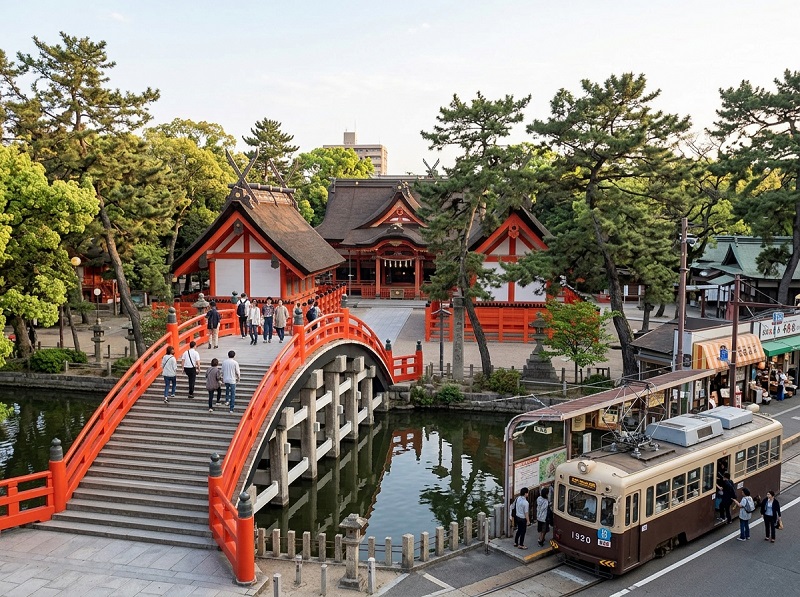
Sumiyoshi Taisha is one of the oldest shrines in Japan. According to tradition, it was founded in the third century. The main halls are built in an early Japanese style with straight roofs and red-painted wood, from a period before Buddhist architecture spread through the country.
Visitors enter across the Sorihashi, a steeply arched red bridge. Crossing it is believed to purify you. Sailors and merchants have prayed here for safe journeys and good business for centuries. The old Hankai tram stops right outside, and the slow ride through local neighbourhoods is a pleasant way to arrive.
Magelline’s Perspective
After a few days in Kyoto, Osaka can come as a surprise. People are louder, the food is cheaper and the evenings last longer. It suits travellers who like to eat well and talk to locals, and one night here is usually enough to make you want another.