 Armenian
 German
 Spanish
 Munich Raises Its Glass
 2026-10-03 14:00:00
The first sound you notice is the brass. It drifts over the Theresienwiese long before the tents come into view, mixing with the smell of roasted almonds and woodsmoke. Then the crowd thickens, the dirndls and leather breeches multiply, and Munich reveals the festival it has been preparing for all year.
Oktoberfest is the largest folk festival on earth, and every autumn it draws millions of people to a single meadow on the edge of the old city. Locals simply call it the Wiesn. Spend a few hours there and you start calling it that too.
A Royal Wedding That Never Ended
The story begins in October 1810, when Crown Prince Ludwig of Bavaria married Princess Therese. The people of Munich were invited to celebrate on the fields outside the city gates, and the day ended with a horse race. The fields were named after the bride, and the party was repeated the following year. And the year after that.
Over two centuries, the horses disappeared, the beer arrived, and the festival moved into September to catch warmer evenings. Today it lasts about two and a half weeks. It opens on a Saturday in the second half of September and closes on the first Sunday of October, or on 3 October if that day comes later.
Dressed for the Wiesn
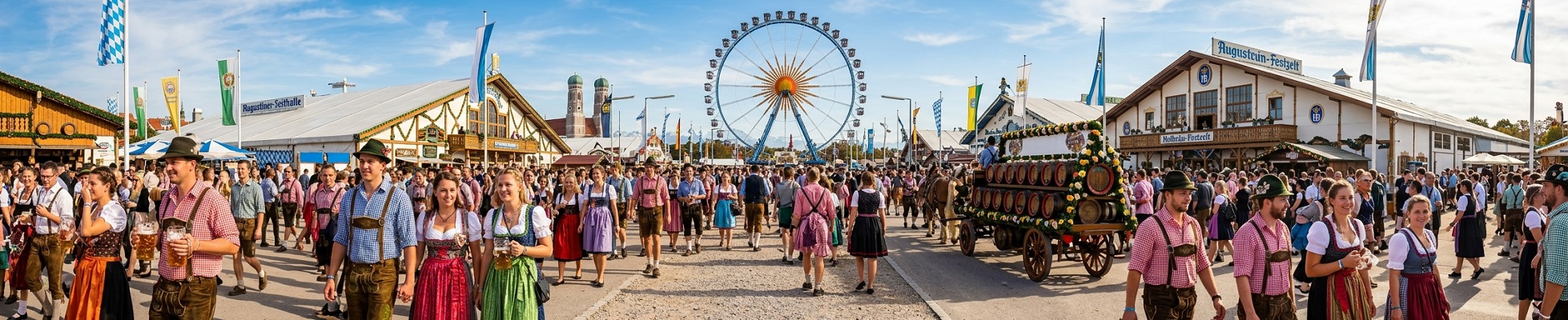
Most visitors come in Tracht, the traditional Bavarian costume. Men wear Lederhosen, short leather trousers with embroidered braces, together with a checked shirt, thick wool socks and sturdy shoes. Some add a felt hat decorated with a tuft of chamois hair. Women wear the dirndl, a fitted bodice over a white blouse with a full skirt and an apron. The bow of the apron carries a small secret: tied on the left means single, on the right means taken, at the back means widowed. Plenty of Munich families keep their best Tracht for years and pass it down.
Inside the Tents
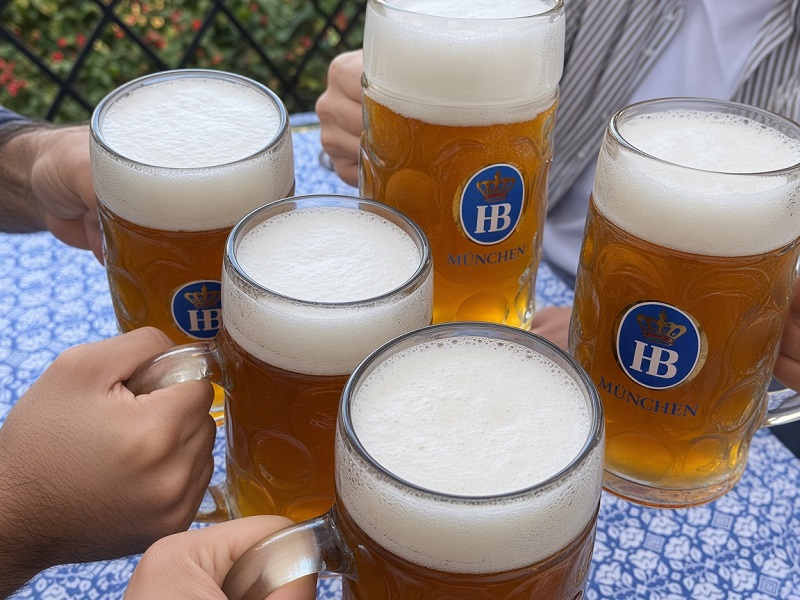
Only Munich breweries are allowed to pour at the Wiesn. Augustiner, Paulaner, Spaten, Löwenbräu and Hofbräu all bring a special festival brew, stronger and more golden than their everyday beer. It is served in the Maß, a heavy glass mug holding a full litre, and carrying four of them at once is a skill the waitresses take seriously.
At noon on opening day, the mayor of Munich strikes a tap into the first barrel and calls out "O'zapft is!", meaning it is tapped. Twelve cannon shots follow, and only then can the beer flow.
Songs
Every big tent has its own band, usually sitting on a raised stage in the middle. During the day they play Bavarian brass music, marches and polkas. Every twenty minutes or so comes the short toast song "Ein Prosit der Gemütlichkeit", and the whole tent rises, lifts its mugs and drinks together. By evening the program turns into a giant sing along. The "Fliegerlied" gets everyone flapping their arms like birds, German party hits fill the gaps, and international favourites like "Country Roads" or "Sweet Caroline" have thousands of strangers singing on the benches.
What to Eat Between Rounds
Half a roast chicken with crisp, salty skin is the classic order. Giant pretzels hang from wooden stands, Weißwurst arrives in the morning with sweet mustard, and grilled fish on long sticks turns slowly over glowing coals. For something sweet, look for gingerbread hearts on ribbons, decorated with icing words of love. People buy them for each other and wear them around their necks all day.
Beyond the Beer
The Wiesn is also an enormous fairground, with roller coasters, a giant Ferris wheel looking toward the Alps on clear days, and old wooden rides that have been spinning for generations. On the first Sunday, thousands march through the city centre in the costume parade, with brewery wagons pulled by horses and bands from all over Bavaria. In the southern corner, the Oide Wiesn keeps the spirit of a century ago with historic rides and folk dancing.
Tipps
Weekday mornings are the easiest time to find a seat without a reservation, while weekends fill up fast after lunch. Cash is handy, prices climb every year, and Munich hotels get booked many months ahead.
Magelline’s Perspective
Oktoberfest could easily be dismissed as one long party, but there is something touching under the noise. Strangers share benches and songs, families keep traditions alive across generations, and a whole city takes two weeks to celebrate simply being together. Come for the beer if you like. You will probably remember the people at your table much longer.