 Armenian
 German
 Spanish

 2026-10-08 00:00:00
Busan is South Korea’s great coastal city and its busiest port, set at the southeastern tip of the peninsula where every street seems to lean toward the water. Fishing boats crowd the harbour, mountains press the neighbourhoods into the coast, and the smell of salt and grilled fish follows you even into the subway. Korea’s second city has none of Seoul’s polished hurry. It moves at its own pace, loud, warm and unapologetically rough around the edges, and that is exactly why travellers fall for it.
A City Shaped by History
Busan has been a port for centuries, a gateway for trade with Japan and the wider Pacific. Its defining chapter came during the Korean War, when it became one of the few places never captured and served as the temporary capital of the South. Hundreds of thousands of refugees poured in and built homes wherever they could, often on steep hillsides with whatever materials they found. Much of today’s Busan grew out of those years. The UN Memorial Cemetery in Nam District, the only one of its kind in the world, keeps that memory quiet and dignified among neat lawns and flags from many nations.
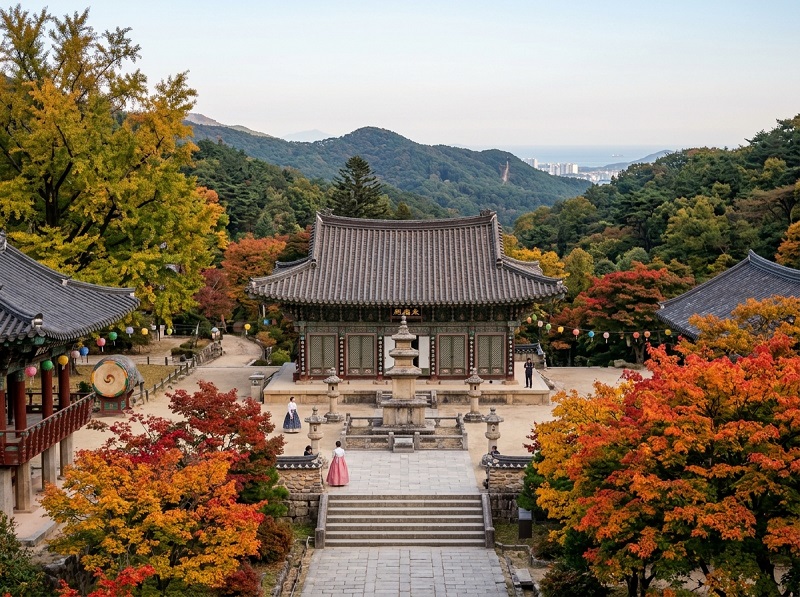
Buddhism runs just as deep. Beomeosa Temple, founded in the 7th century on the slopes of Geumjeongsan Mountain, still welcomes monks and visitors along its forest paths, and the morning drums there are worth the early start.
Places You Should Not Miss
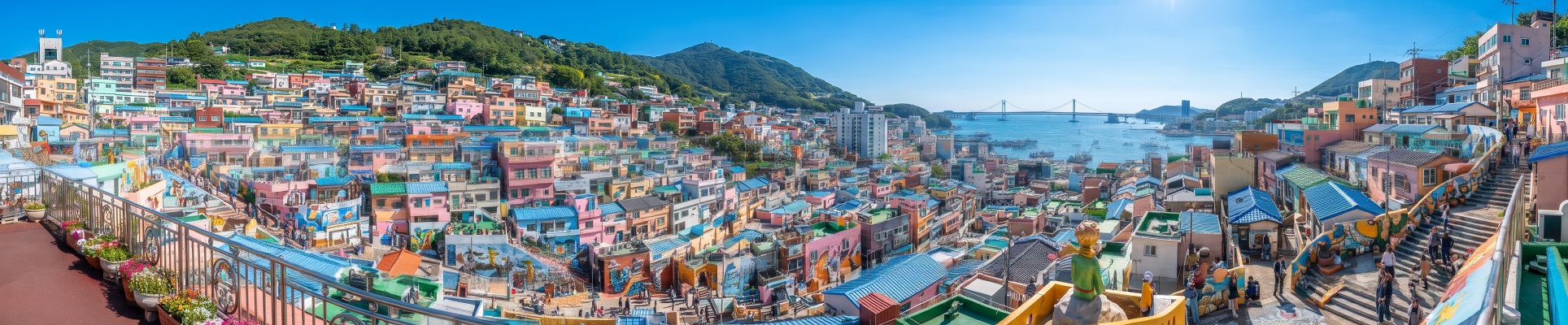
Built by refugees on a sheer hillside, Gamcheon Culture Village is a sprawling cascade of pastel houses, with murals, tiny galleries and rooftop views over the port. Wear good shoes, because the stairs never seem to end.
Haedong Yonggungsa is one of the rare Korean temples built right on the seashore. Waves break against the rocks below the pagoda, and at sunrise the whole place glows gold.
Haeundae Beach is the famous one, a long curve of sand backed by towers, while Gwangalli feels younger and livelier, with cafés facing the Gwangan Bridge as it lights up at night. On Yeongdo Island, the cliffs of Taejongdae drop straight into the sea, and the walking trails there give you Busan at its wildest.
Down at the water, Jagalchi Fish Market is where Busan’s pulse beats fastest. Rows of tanks hold octopus, eels, crabs and creatures you may not recognise. The women who run the stalls, known locally as Jagalchi ajimae, have been the face of this market for generations. Pick your fish downstairs and they will cook it for you upstairs.
Food With a Busan Accent
Busan eats differently from the rest of Korea. Dwaeji gukbap, a milky pork and rice soup, is the city’s comfort food, eaten at any hour with chives and a spoon of salted shrimp. Milmyeon, cold wheat noodles in an icy broth, was born during the war when refugees adapted northern buckwheat noodles to the flour they could get. Fish cakes called eomuk are a local pride, sold hot on skewers with cups of broth on every corner.
In Nampo Dong, look for ssiat hotteok, sweet pancakes fried and split open to be stuffed with sunflower and pumpkin seeds. And if you visit Dongnae, the old town, order Dongnae pajeon, a thick green onion pancake once served to royalty.
Festivals and Traditions
Every October the Busan International Film Festival fills the city with directors, actors and film lovers, and it remains the most important film event in Asia. In autumn the Busan Fireworks Festival turns Gwangalli into a sea of faces watching the bridge explode with colour. Before Buddha’s Birthday in spring, lantern lines cover the temples, and Samgwangsa becomes a ceiling of light.
Like all Koreans, Busan families gather for Seollal, the Lunar New Year, and Chuseok, the autumn harvest festival. Markets get busy weeks in advance, and people travel home to bow to their elders, share rice cakes and visit ancestral graves.
The People of Busan
Locals speak the Gyeongsang dialect, which sounds sharp and fast to outsiders. Koreans from other cities sometimes call Busan people blunt, but spend an evening with them and you will find the opposite. They are direct because they have nothing to hide, and generous once you share a table. Watch a Lotte Giants baseball game at Sajik Stadium and you will see the city at full volume: thousands of fans singing the old song “Busan Galmaegi” and wearing orange plastic bags on their heads. Nobody explains it to you. You just join in.
Magelline Perspectives
Busan is the Korea that smells of the sea and speaks its mind. Come for the beaches and temples, stay for a bowl of gukbap at midnight and a conversation with someone who has lived by this harbour all their life. Gimhae International Airport sits just outside the city, and the light rail from the terminal links straight into the Busan Metro at Sasang and Daejeo, so you can be in Seomyeon or on the sand at Haeundae within the hour.